

A New Cosmic Cartographer
Set to begin its work after a successful launch, the Nancy Grace Roman Space Telescope is NASA's next great astrophysics observatory. Named for the agency's first chief of astronomy, the so-called 'mother of Hubble', Roman is not designed to replace its predecessors
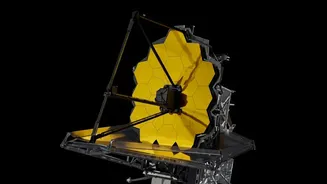
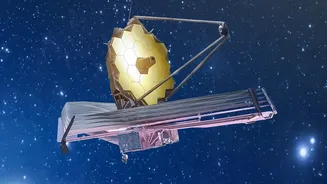
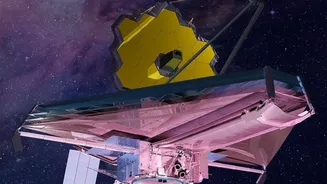
like Hubble or the James Webb Space Telescope (JWST). Instead, it serves a revolutionary new purpose: speed and scale. While Hubble and Webb excel at zooming in on specific targets with incredible depth, Roman will do the opposite. It will perform massive surveys, capturing enormous swathes of the sky with remarkable speed. Its primary mission is to tackle some of the biggest questions in cosmology, including the nature of dark energy and dark matter, while also conducting a sweeping census of planets beyond our solar system. It's less of a microscope and more of a grand map-maker, designed to chart the cosmic territory on an unprecedented scale.
What a 'Huge Field of View' Really Means
The key to Roman's power is its immense field of view. Imagine looking at the night sky through a drinking straw—that's a simplified way to think of how many traditional telescopes operate. They see a tiny patch in great detail. Roman, by comparison, offers a view from a massive bay window. Its Wide Field Instrument can capture an area of the sky at least 100 times larger than Hubble's infrared camera in a single shot, all while maintaining a similar, tack-sharp resolution. If Hubble were tasked with imaging the Pillars of Creation, it would see just the iconic dusty columns. Roman, in the same amount of time, could capture not only the pillars but the vast star-forming nebula surrounding them. This leap in efficiency is staggering; what might take Hubble years to survey, Roman can accomplish in mere days or weeks. This ability to see both the trees and the entire forest is what will fundamentally change space surveys.
Solving the Dark Universe Puzzle
Approximately 95% of the universe is made of dark energy and dark matter, mysterious components we cannot directly see. Scientists know they exist because of their gravitational effects on the things we can see. Roman is uniquely equipped to probe these mysteries. By imaging billions of galaxies across cosmic time, the telescope will map the large-scale structure of the universe. This will allow astronomers to study how the universe's expansion has accelerated over eons—a phenomenon attributed to dark energy. The telescope will use several methods, including observing distant supernovae and measuring how the light from faraway galaxies is subtly bent by the gravity of intervening dark matter, a technique called weak gravitational lensing. By creating such a vast and detailed 3D map of matter, Roman will provide the statistical power needed to test theories about these enigmatic forces shaping our cosmos.
The Ultimate Exoplanet Hunter
Beyond cosmology, Roman is poised to revolutionize the search for exoplanets. While missions like Kepler and TESS found thousands of planets by watching for the dip in starlight as a planet transits its star, Roman will add a powerful new technique to the hunt at a massive scale: gravitational microlensing. This method detects planets by observing how their gravity, combined with their host star's, bends and magnifies the light from a much more distant, unrelated star that happens to align perfectly. Microlensing is especially good at finding planets far from their star, in orbits similar to Jupiter or Saturn, as well as rogue planets that drift through the galaxy without a star to call their own. Scientists anticipate that Roman's surveys toward the dense star fields at the center of our Milky Way will uncover thousands of new worlds, creating a statistical census that will tell us how common different types of planetary systems truly are.