





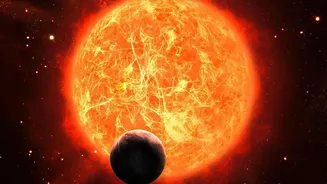
A Glimpse into Alien Skies
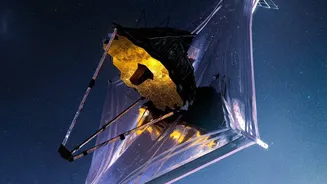
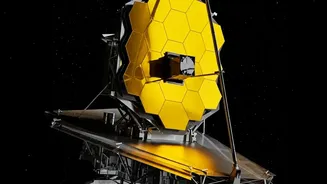
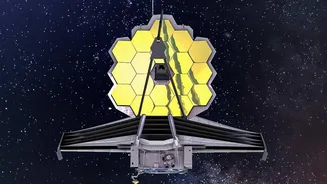
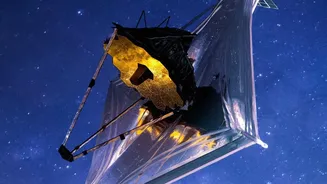
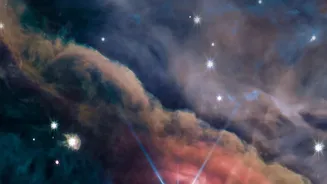
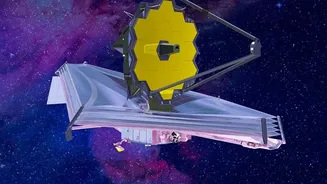
The James Webb Space Telescope is delivering on its promise to revolutionize our understanding of the cosmos, providing an unprecedented look into the atmospheres of planets orbiting distant stars. In a series of breakthrough observations, the telescope
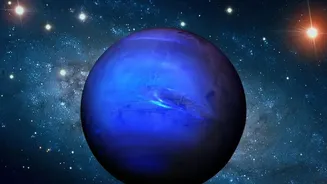
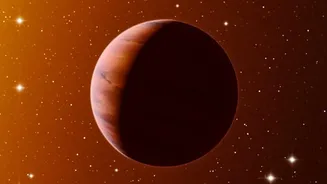
has captured the distinct signature of water vapour on several exoplanets, ranging from hot, puffy gas giants to smaller, rocky worlds. One of the first and most detailed observations was of WASP-96 b, a gas giant about 1,150 light-years away. JWST’s sensitive instruments didn't just confirm water; they provided a detailed spectrum revealing evidence of clouds and haze, painting a complex picture of a faraway world's weather. These findings, which analyse the tiny decreases in starlight as it filters through a planet's atmosphere, are the most detailed of their kind to date.
The Ghostly Signature of Water
So, how does a telescope see water from hundreds or thousands of light-years away? The technique is called transmission spectroscopy. As an exoplanet passes in front of its host star from our perspective, a tiny fraction of the starlight shines through the planet’s atmosphere. The gases in that atmosphere absorb specific colours, or wavelengths, of light. Each molecule has a unique chemical fingerprint. For water, this signature is unmistakable to JWST's powerful infrared spectrographs. By capturing and analysing the light that reaches it, the telescope can identify which molecules are present, their abundance, and even gain insights into the atmosphere's temperature and dynamics. This method has allowed scientists to detect not only water but also carbon dioxide, methane, and sulfur dioxide on various worlds, opening a new chapter in characterising exoplanets.
More Than Just a Drop
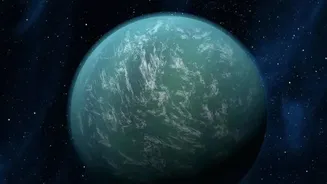
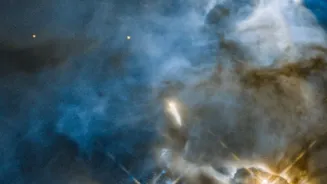
Detecting water vapour is a monumental step, but not all water-bearing planets are created equal. The discoveries span a wide range of planetary types. For instance, WASP-39 b, a “hot Saturn” 700 light-years away, showed signs of active chemistry, with sunlight driving reactions in its upper atmosphere, similar to how ozone is formed on Earth. On the super-Earth LHS 1140 b, a cooler world just 49 light-years away, the detection of water vapour suggests it could potentially support liquid water on its surface, making it a prime target in the search for habitable environments. More recently, JWST found water in the inner, rocky-planet-forming zone of the PDS 70 system, suggesting that planets similar to Earth could be born with water already present. This discovery is crucial because it touches on the long-debated question of how Earth got its water.
The Search for Life's Building Blocks
While finding water vapour is not the same as finding life, it is a critical prerequisite. Water is the universal solvent on Earth, essential for the chemical reactions that make life possible. The most tantalising discoveries are those that hint at potential biosignatures. On exoplanet K2-18 b, a sub-Neptune 124 light-years away, JWST found not only water vapour and methane but also a possible trace of dimethyl sulfide (DMS) — a molecule that, on Earth, is primarily produced by life. While this is far from conclusive proof, it demonstrates JWST’s ability to detect the very molecules that could point to biological processes on other worlds. These findings help scientists build a census of planetary atmospheres, understanding which worlds are hazy, which are clear, and which might just have the right conditions for life to begin.