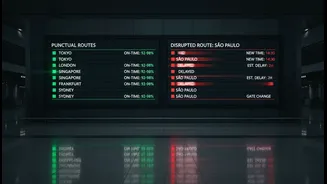









Why Punctuality Is the New Priority
In the current era of high travel demand, airports and airlines are under immense pressure. This has led to an increase in operational challenges, from crowded tarmacs to staff shortages, resulting in more frequent delays and last-minute cancellations.
For travellers, the consequences range from missed connections and ruined plans to added expenses for hotels and food. Faced with this unpredictability, passengers are no longer just looking for the cheapest fare or the most convenient schedule; they are prioritising reliability. Checking an airline's on-time performance (OTP) has shifted from a niche hack for aviation enthusiasts to a mainstream travel strategy. It provides a data-backed glimpse into an airline's ability to stick to its schedule, empowering travellers to make choices that minimise their risk of disruption.
Your Guide: Where to Find Reliable OTP Data
Finding airline punctuality records is easier than you might think. For Indian travellers, the primary official source is the Directorate General of Civil Aviation (DGCA). The DGCA publishes monthly reports detailing the OTP of domestic airlines operating out of major metro airports like Delhi, Mumbai, Bengaluru, and Hyderabad. This data offers a clear, unbiased look at how local carriers are performing. Beyond government sources, several global platforms provide comprehensive data. Websites and apps like FlightAware, FlightStats by Cirium, and OAG's FlightView offer real-time flight tracking, historical performance data, and airport delay information. These services often allow you to check the OTP for a specific flight number over the past few months, giving you a very targeted risk assessment before you book.
How to Read the Numbers Like a Pro
Understanding OTP data is straightforward. A flight is generally considered 'on-time' if it arrives at or departs from the gate within 15 minutes of its scheduled time. So, an airline with an 85% OTP rating means that 85 out of 100 of its flights met this 15-minute window. When researching, don't just look at the airline's overall score. Drill down into the specific route you plan to take, if possible. An airline might have a great overall record but struggle on a particular high-traffic route. Also, consider the time of year. Performance often dips during monsoon season due to weather, or in winter in North India because of fog. A consistently high OTP of over 80% is generally considered good, but comparing the numbers between two or three potential airlines for your chosen route is the most effective way to use the data.
The Indian Scenario: Who Leads in Punctuality?
In the competitive Indian aviation market, punctuality is a key differentiator. According to recent DGCA reports, IndiGo has consistently been a frontrunner, often posting an OTP in the 80-85% range, thanks to its efficient operations. Newcomer Akasa Air has also shown strong performance, frequently coming in a close second with OTP figures between 78% and 82%. Air India, under its new management, is showing significant improvement in its operational reliability, with recent global reports placing it among the top performers worldwide for certain months. At the other end of the scale, some carriers may show more variability. The key is to check the most recent monthly data, as performance can fluctuate. The DGCA reports are your best guide for an objective comparison of domestic carriers.
Beyond the Data: A Few Final Checks
While OTP data is incredibly useful, it's one part of a larger picture. A single bad month due to unforeseen circumstances shouldn't necessarily disqualify an airline forever. Look for trends over several months. Also, consider the timing of your flight. The very first flights of the morning are often the most punctual, as they are less susceptible to the cascading effect of delays that build up throughout the day. Finally, remember that even the most punctual airline can have a bad day. Factors like air traffic control, security, and weather are outside any single airline's control. Using OTP data isn't about finding a flight that is guaranteed to be on time; it's about playing the odds and choosing the option with the statistically lowest chance of delay.