





The Science of a Safe Return
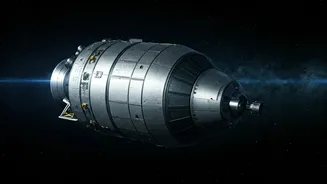
When a spacecraft hurtles back to Earth, it’s a controlled fall. The Gaganyaan crew module, for instance, will re-enter the atmosphere at blistering speeds. To bring our astronauts back safely, this immense velocity must be scrubbed off. This is where
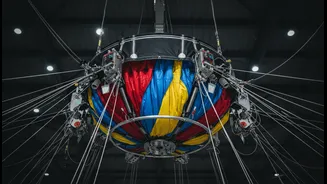
the parachute system, the unsung hero of mission safety, comes into play. 'Canopy inflation dynamics' is the technical term for how these massive parachutes deploy, unfurl, and behave under extreme stress. It's a field of study where physics, aerodynamics, and materials science collide. Getting it wrong isn't an option, which is why ISRO dedicates thousands of hours to evaluating every millisecond of the process long before a mission ever leaves the ground.
Digital Rehearsals in a Supercomputer
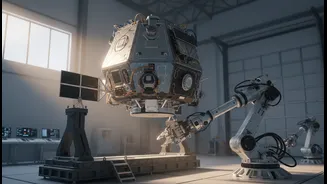
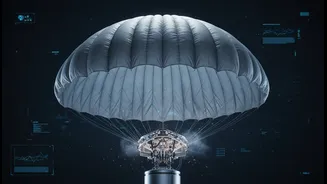
Before a single piece of fabric is cut, the entire parachute deployment sequence is rehearsed countless times inside a supercomputer. ISRO engineers use powerful software for Computational Fluid Dynamics (CFD) to simulate the chaotic environment the parachutes will face. This software, including ISRO's own 'PraVaHa' tool, creates a virtual model of the crew capsule and its parachutes. Engineers can then simulate the exact conditions of re-entry—the thin atmosphere, the supersonic speeds, and the turbulent wake behind the capsule. These simulations help predict the immense forces that will act on the canopy as it inflates. This digital-first approach allows engineers to identify potential failure points, optimize the parachute design, and refine the deployment timing, all without the enormous cost and risk of a real-world test.
Gaganyaan's Ten-Parachute Orchestra
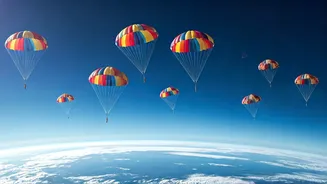
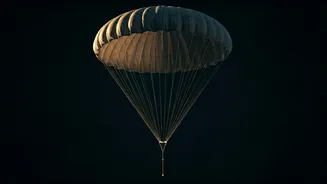
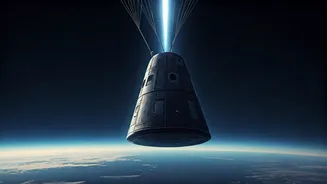
The parachute system for India's Gaganyaan mission is not a single canopy but a meticulously choreographed orchestra of ten parachutes of four different types. The sequence begins after re-entry, when two Apex Cover Separation parachutes jettison the cover protecting the main chutes. Next, two Drogue parachutes deploy. These smaller, stronger parachutes are critical for stabilizing the wildly oscillating capsule and reducing its speed from supersonic to subsonic. Only when the module is stable and slow enough do three pilot chutes fire to pull out the three massive main parachutes. This clustered, redundant design ensures that even if one main parachute fails, the other two can safely land the crew module. This entire sequence, from apex cover to splashdown, is what engineers are simulating and testing.
From Simulation to Reality: Drop Tests
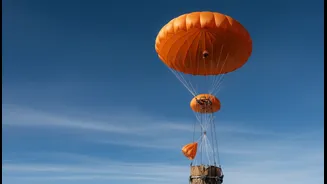
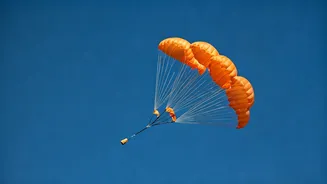
Digital simulations are powerful, but they must be validated against real-world data. ISRO conducts a rigorous series of physical tests to prove their models are accurate. In recent tests for the Gaganyaan mission, such as the Integrated Main Parachute Airdrop Test (IMAT) series, test articles are dropped from high-altitude platforms. An Indian Air Force IL-76 aircraft, for example, will fly to an altitude of 2.5 km and drop a payload simulating the crew module's mass. Instruments on the payload and high-speed cameras record every aspect of the deployment, from the firing of the mortars that deploy the chutes to the final, gentle descent. Recent tests at the ADRDE drop zone in Madhya Pradesh have successfully qualified the main parachutes under maximum expected load conditions, a huge confidence boost for the upcoming uncrewed G1 mission.
Pushing the Limits on the Ground
Not all tests happen in the air. To test the drogue parachutes, which must function at higher speeds, ISRO uses facilities like the Rail Track Rocket Sled (RTRS) in Chandigarh. Here, a test article is accelerated to high speeds along a railway track, simulating the forces experienced during re-entry and allowing engineers to test the deployment mechanisms under extreme stress. These tests have been used to validate crucial innovations like 'reefing', a technique that makes the parachute open in stages to prevent the canopy from tearing itself apart under the initial shock load. By combining digital simulations, high-altitude drops, and ground-based sled tests, engineers build a complete picture of the parachute's performance, ensuring its reliability for the most important mission: bringing our astronauts home.