





A Breakthrough in the Search for Other Worlds
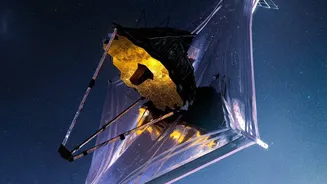
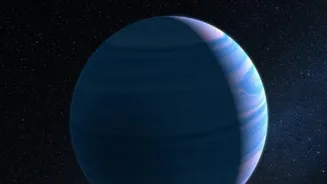
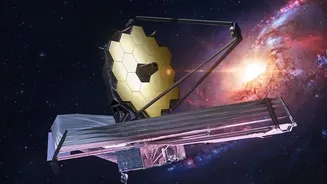
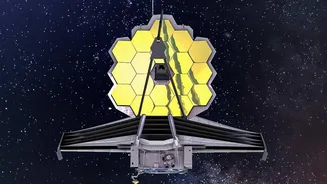
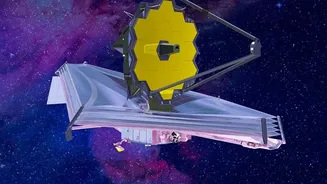
In a landmark finding, astronomers have used the powerful infrared capabilities of the James Webb Space Telescope to identify signs of water vapour around rocky exoplanets. While water has been found on gaseous giants before, detecting it in the atmosphere
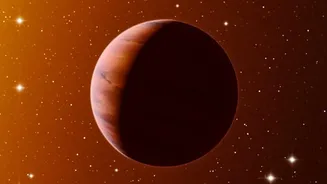
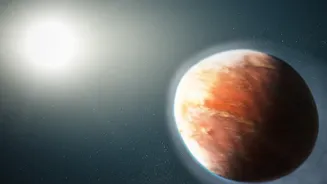
of a potentially rocky world is a monumental step forward. One such observation involved a planet designated GJ 486 b, a rocky world about 26 light-years away. Researchers saw hints of water, but they remain cautious, noting that the signal could originate from the star itself rather than the planet. Another exciting discovery was the presence of water vapour in the inner, planet-forming disk of a young star system called PDS 70. This suggests that the raw materials for water-rich rocky planets, like Earth, are available from the very beginning of their formation.
How Webb Sees What No Other Telescope Can
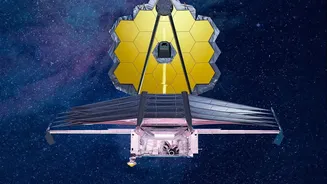
So, how does the JWST detect a substance like water from hundreds of light-years away? The technique is called transmission spectroscopy. When an exoplanet passes in front of its host star from our perspective, a tiny fraction of the starlight filters through the planet's atmosphere. Different molecules in the atmosphere absorb specific wavelengths, or colours, of this light, leaving a unique chemical fingerprint. JWST's highly sensitive instruments, like the Near-Infrared Spectrograph (NIRSpec) and the Mid-Infrared Instrument (MIRI), are designed to capture and analyze this light. By looking at which parts of the light spectrum are missing, scientists can determine which gases are present, including the distinct signature of water. This method is so precise it can mark the difference between a dry, barren world and one with a potentially rich atmosphere.
What Does 'Earthlike' Actually Mean?
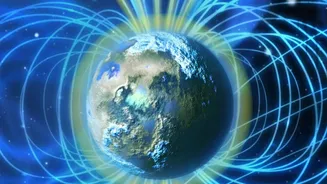
The term 'Earthlike' can be misleading. It doesn't mean we've found a world with blue oceans and green continents. In astronomy, 'Earthlike' or 'terrestrial' refers to a planet that is rocky, roughly the size of Earth, and orbits within its star's habitable zone. The habitable zone, often called the 'Goldilocks zone,' is the orbital distance where temperatures are just right—not too hot and not too cold—for liquid water to potentially exist on the planet's surface. Planets like GJ 486 b are considered rocky, but it orbits too close to its star, resulting in a scorching surface temperature of around 430 degrees Celsius, making it uninhabitable. The key takeaway is that scientists are first looking for worlds with the right physical properties before they can even begin to assess them for signs of life.
More Than Just Water
Detecting water is a critical first step, but it is not the only ingredient for life as we know it. To truly assess a planet's potential for habitability, scientists are looking for a cocktail of atmospheric gases. Along with water vapour, JWST is searching for biosignatures—gases like methane, oxygen, and carbon dioxide. The presence of methane alongside water vapour was recently confirmed in the atmosphere of the exoplanet WASP-80 b. Finding a combination of these gases could indicate geological or even biological activity. A planet with an atmosphere rich in both oxygen and methane, for instance, would be extremely compelling, as these two gases tend to destroy each other and their coexistence suggests they are being continuously replenished, possibly by life.
The Journey Ahead in a New Era of Astronomy
These initial detections are just the beginning. Each discovery raises new questions and requires further investigation. For GJ 486 b, scientists will use other JWST instruments to determine if the water signal is truly from a planetary atmosphere or a mirage created by cool spots on its star. For systems like PDS 70, the goal is to see if the water vapour in the protoplanetary disk actually gets incorporated into newly forming planets. The JWST has moved the search for habitable worlds from a theoretical exercise to an observational one. While the road to confirming an inhabited world is long and complex, these findings prove we now have the technology to follow the trail of water across the galaxy and ask if we are alone in the universe.