



A Journey of a Thousand Brakes
Getting to Mercury is surprisingly difficult. While one might think a trip toward the sun is a straightforward fall inward, the opposite is true. Any spacecraft heading for Mercury gets aggressively accelerated by the sun's immense gravity. To avoid overshooting
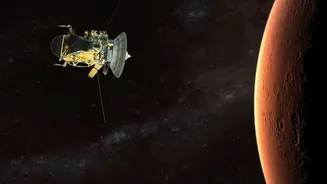
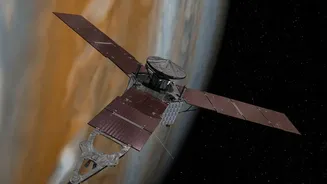
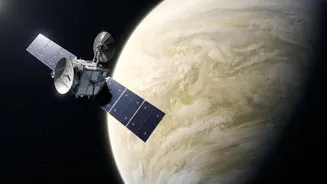
the planet, BepiColombo had to constantly apply the brakes. Launched in October 2018, the mission has spent years shedding speed through a complex series of nine planetary flybys: one of Earth, two of Venus, and six of Mercury itself. Each flyby used the planet's gravity to slow the spacecraft down, gradually shaping its path for the ultimate encounter. This complex trajectory, originally planned for seven years, was extended after a solar panel issue in 2024 required engineers to devise a new, lower-thrust route, pushing the arrival to late 2026.
The Beginning of the End
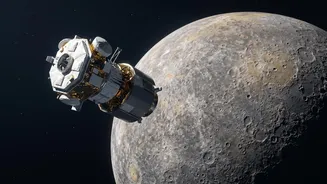
The final approach phase officially kicked off on September 3, 2026, with a critical milestone: the separation of the Mercury Transfer Module (MTM). This module, which provided the primary power and propulsion for the long cruise, has now been jettisoned, leaving the two science orbiters to complete the journey. This event marks the start of a new, six-month-long sequence of operations. Unlike missions that enter orbit with a single, dramatic burn, BepiColombo's arrival is a slow, careful dance. The spacecraft will be 'weakly captured' by Mercury's gravity around November 21, 2026, after which a series of 16 maneuvers will progressively lower and refine its orbit around the planet.
A Tale of Two Orbiters
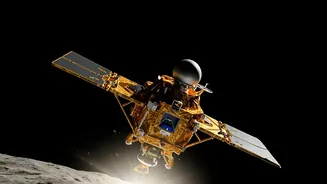
BepiColombo is a joint mission between the European Space Agency (ESA) and the Japan Aerospace Exploration Agency (JAXA), and it carries two orbiters designed to work in tandem. ESA's Mercury Planetary Orbiter (MPO) will focus on studying the planet's surface, composition, and interior. JAXA's Mercury Magnetospheric Orbiter (Mio) will investigate Mercury's mysterious magnetic field and its interaction with the solar wind. After orbit insertion, the two spacecraft will remain stacked together for a few more weeks. Their separation is scheduled for December 9-10, 2026, after which they will move into their own distinct, complementary orbits.
Surviving the Inferno to Solve Mysteries
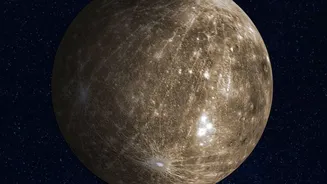
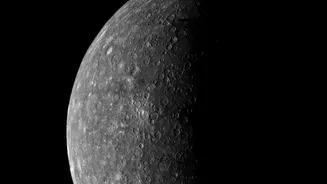
Operating a spacecraft at Mercury is an extreme engineering challenge. The sun is about 10 times more intense there than it is at Earth, and surface temperatures can reach 450°C, hot enough to melt lead. BepiColombo is equipped with advanced insulation, radiators, and sunshields to survive this harsh thermal environment. The scientific payoff for enduring these conditions is immense. Mercury is the least-explored rocky planet in our inner solar system. Scientists hope BepiColombo will help answer fundamental questions: Why is Mercury's core so abnormally large? How does it generate a magnetic field when other rocky planets like Venus and Mars do not? And is there really water ice hidden in permanently shadowed craters at its poles? The mission will provide the most comprehensive look at this enigmatic world to date.
What Happens Next?
With the transfer module now gone, the MPO and Mio orbiters are flying under their own power. Following the crucial orbit insertion in November and their separation in December, ground teams will spend several months commissioning the spacecraft and their scientific instruments. If all goes according to plan, the main science mission is set to formally begin in April 2027. For at least one Earth year, the two orbiters will simultaneously gather data, providing a dual perspective that will revolutionize our understanding of the small, scorched planet closest to our sun. The eight-year cruise may be over, but for the scientists and engineers, the real mission is just about to begin.