





A Universe Shrouded in Fog
In the first few hundred thousand years after the Big Bang, the universe was a hot, dense soup. As it expanded and cooled, it became filled with a vast, opaque cloud of neutral hydrogen gas. This wasn't a fog you could walk through, but a cosmic one that
effectively made the entire universe non-transparent to energetic forms of light, like ultraviolet. For hundreds of millions of years, during a period sometimes called the Cosmic Dark Ages, this mist blanketed everything. Any light from the very first stars that began to form would have been immediately swallowed by the surrounding hydrogen.
The Great Clearing: A Cosmic Whodunit
Gradually, over a period lasting up to a billion years after the Big Bang, something monumental happened. This hydrogen fog was systematically burned away in a process astronomers call the Epoch of Reionization. Essentially, something produced enough high-energy radiation to strip the electrons from the hydrogen atoms, turning the opaque gas into a transparent, ionized plasma. This transformed the state of the entire universe, allowing light to travel freely across vast distances for the first time. For decades, astronomers have debated the source of this universe-altering energy, with the primary suspects being powerful, supermassive black holes (quasars) or large, bright galaxies.
An Unexpected Culprit Emerges
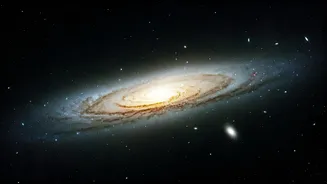
While quasars and large galaxies were once the leading candidates, there was a problem: they didn't seem to be numerous enough in the early universe to get the job done. The evidence is now pointing to a much smaller, but far more numerous, hero: the dwarf galaxy. Recent discoveries suggest that swarms of these tiny galaxies, some 100 times smaller than our own Milky Way, were the true engines of reionization. The main surprise for scientists is that these faint, small galaxies could have so much collective power.
The Technological Game-Changer
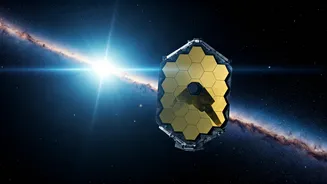
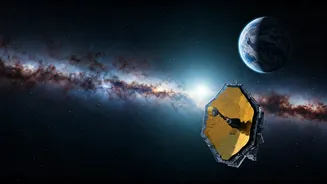
Proving this theory was incredibly difficult because these early dwarf galaxies are exceptionally faint and distant. This is where the business of big science and revolutionary technology comes in. The James Webb Space Telescope (JWST), a multi-billion dollar international project, was specifically designed to capture the faint infrared light from the dawn of time. In some cases, astronomers are also using a natural phenomenon called gravitational lensing—where a massive galaxy cluster in the foreground acts like a cosmic magnifying glass—to get an even better look at these early sources. This combination of cutting-edge engineering and cosmic physics is what has finally allowed us to test these long-held theories.
The Smoking Gun Evidence
Using the Webb and Hubble telescopes, astronomers have now directly observed this process in action. Studies of galaxies like MXDFz4.4 show them actively pumping out huge amounts of ultraviolet radiation. Despite being much smaller than the Milky Way, this galaxy is forming stars about ten times faster. This intense burst of star formation crams many young, hot, massive stars into a very small space, creating a powerhouse of radiation strong enough to punch holes in the surrounding hydrogen fog. Recent findings show these dwarf galaxies are immense producers of this radiation, at levels four times larger than previously assumed, making them more than capable of reionizing the entire universe.