


The Urban Stargazing Challenge
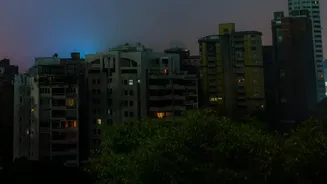
For anyone living in a major metropolitan area like Mumbai, Delhi, or Bengaluru, the night sky often appears as a blank, orange-tinged canvas. This phenomenon, known as light pollution, is caused by excessive artificial light from streetlights, buildings,
and advertisements. This light scatters in the atmosphere, creating a persistent glow that drowns out all but the brightest celestial objects, like the Moon and a few prominent planets. It’s a common frustration for aspiring astronomers, making the universe feel distant and inaccessible. But while you can't turn off the city lights, you can use technology to see what you're missing.
Your Phone is a Portable Planetarium
The single most powerful tool for an urban astronomer is the modern smartphone. A host of sophisticated yet user-friendly apps can transform your device into a window to the universe. Apps like SkyView, Stellarium Mobile, and Star Walk 2 use your phone’s built-in GPS, compass, and gyroscope to generate an accurate map of the sky in real-time. Simply point your phone towards any part of the sky, and the app will show you exactly what stars, constellations, planets, and even satellites are in that direction. The augmented reality (AR) feature in many of these apps overlays this information directly onto your camera's view, creating an intuitive and interactive experience.
Identifying Objects Through the Haze
While these apps cannot physically cut through light pollution, they solve the primary problem for beginners: knowing what you're supposed to be looking for. Even in a bright city, you can often spot a few key stars. By using an app to identify that one bright 'star' as Jupiter, or tracing the faint outline of the Big Dipper, you can begin to navigate the cosmos. Many apps recommended for beginners, like SkyView Lite and Star Walk 2, are designed to be simple and intuitive. They allow you to tap on any object to get more information, from its name and mythology to its distance and composition. Some, like Stellarium, are praised for their highly realistic sky simulations.
Planning Your Night Out (or In)
Beyond real-time identification, mobile tools are invaluable for planning. Apps like Sky Tonight and the official NASA app can provide a calendar of upcoming celestial events. You can set reminders for meteor showers, planetary conjunctions, and, most excitingly for urban viewers, passes of the International Space Station (ISS). The ISS is often bright enough to be clearly visible as it streaks across the sky, even from a city balcony. Specialised apps like ISS Detector are designed specifically to help you spot it. This planning feature turns stargazing from a random activity into an intentional event, helping you know exactly when and where to look for the most impressive sights.
Your First Step into Astrophotography
Seeing the stars is one thing, but capturing them is another. Modern smartphones, especially those with 'Night' or 'Pro' modes, have made basic astrophotography more accessible than ever. While light pollution remains a challenge, you can still photograph brighter objects like the Moon, planets, and prominent constellations. The key is stability; a small, inexpensive tripod is essential to avoid blurry images during the long exposures needed for night shots. In your phone's manual camera settings, you can experiment with increasing the shutter speed to a few seconds and adjusting the ISO. Even if your first shots aren't perfect, editing them in free apps like Snapseed can help bring out more detail than you could see with your naked eye.