
A Tale of Two Planets
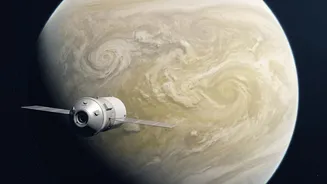
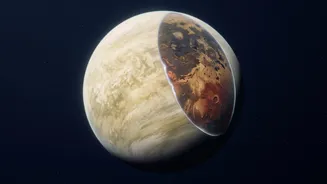
Venus and Earth are similar in size and structure, yet they couldn't be more different. While Earth is a cradle of life, Venus is a hellscape. Its surface is hot enough to melt lead, and the atmospheric pressure is crushing. This dramatic divergence is a critical
puzzle for planetary scientists. Understanding how Venus became a runaway greenhouse, a cautionary tale for our own planet's climate, is a key driver of modern space exploration. The secrets to this divergence aren't just on the surface; they are floating in its atmosphere. The planet is perpetually covered by thick clouds of sulfuric acid, which have long prevented a clear view of the world below.
ISRO's Ambitious Goal: Shukrayaan-1
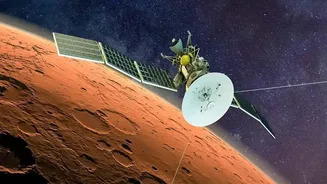
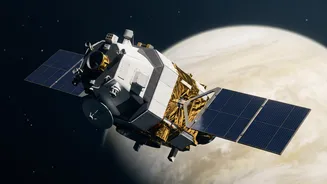
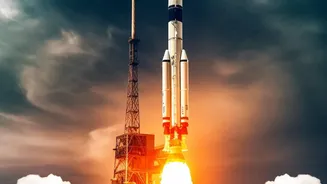
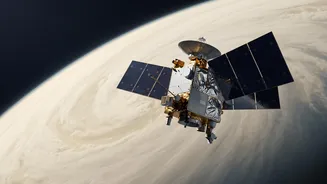
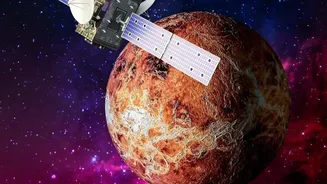
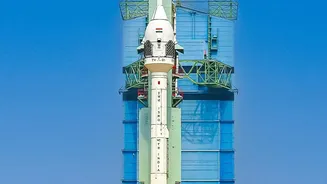
Enter Shukrayaan-1, the Indian Space Research Organisation's planned orbiter mission to Venus. Following the successes of Chandrayaan and the Mars Orbiter Mission (Mangalyaan), Shukrayaan represents India’s next great leap in interplanetary science. While previous missions have studied Venus, Shukrayaan aims to perform a comprehensive investigation of the planet's surface, atmosphere, and its interaction with solar wind. The orbiter will be equipped with a suite of advanced instruments, many developed in India, to conduct this detailed study from a polar orbit. This mission places ISRO among a select group of space agencies daring to unravel the mysteries of our nearest planetary neighbour.
The Breakthrough: Peering into the Clouds
The real breakthrough lies in the mission's focus on atmospheric chemistry. For decades, two major mysteries have tantalized scientists. The first is the 'unknown UV absorber'—a mysterious substance in the clouds that absorbs huge amounts of ultraviolet radiation, much like ozone does on Earth. Some have even speculated this could be linked to microbial colonies. The second is the potential, though highly debated, presence of phosphine gas. On Earth, phosphine is overwhelmingly associated with biological or industrial activity. Its detection in the Venusian clouds in 2020 sparked intense scientific excitement and debate. Shukrayaan-1's sensors are designed to tackle these questions head-on. Instruments like the Venus Infrared Atmospheric Gases Linker (VIRAL), a collaboration with French and Russian agencies, are specifically designed to analyze the atmospheric composition with high precision. By studying these chemical fingerprints, the mission hopes to finally provide concrete answers.
The Right Tools for a Hostile Job
Studying Venus is incredibly challenging. The extreme environment means missions must be robust and technologically advanced. Shukrayaan will carry a payload of around 100 kg, including a high-resolution Synthetic Aperture Radar (SAR) to map the surface through the dense clouds. But for the chemistry, specialized spectrometers and analysers are key. These instruments will analyse the composition and dynamics of the atmosphere, looking for trace gases and studying how they are distributed. An instrument co-developed with Sweden, the Venusian Neutrals Analyser, will study how the solar wind strips away particles from the atmosphere, helping explain how Venus lost its water and became so inhospitable. This combination of instruments makes Shukrayaan a uniquely comprehensive mission, capable of studying the planet from its ionosphere down to its subsurface.
Why This Matters for India and the World
Successfully executing the Shukrayaan mission will be a major milestone for India, cementing its position as a leader in space exploration. The technological challenges overcome will drive innovation and inspire a new generation of scientists and engineers. On a global scale, the data from Shukrayaan will be invaluable. Understanding the runaway greenhouse effect on Venus can refine our own climate models on Earth. Furthermore, the search for answers about phosphine and the UV absorber touches on one of science's most profound questions: are we alone? Whether Shukrayaan finds evidence of unknown geological processes, novel chemistry, or something even more surprising, its investigation into the clouds of Venus promises to rewrite our understanding of Earth's enigmatic twin.