



The Riverfront: A Grand Colonial Welcome
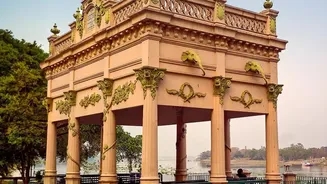
A heritage walk in Kolkata naturally begins at the Hooghly River, the city’s lifeline. Start your exploration at Prinsep Ghat, a stunning Palladian porch built in 1843 in memory of the scholar James Prinsep. Famous for deciphering the Brahmi and Kharoshti
scripts, Prinsep unlocked a significant chapter of ancient Indian history. The ghat, with its Greek and Gothic details, was once a primary landing spot for British royalty. From here, a beautified 2-kilometre stretch of riverfront leads you to Babughat. Commissioned in 1830 by a local zamindar, Babughat’s Doric-Greek pavilion remains a bustling hub for daily rituals, from holy dips to evening pujas, offering an unfiltered view of local life against a colonial backdrop. This stretch along Strand Road, completed in 1828, is a boulevard of architectural history, where the river breeze whispers tales of the British Raj.
Dalhousie Square: The Empire’s Power Centre
A short walk from the riverfront lies B.B.D. Bagh, formerly Dalhousie Square, the undisputed administrative heart of British India. This area boasts one of the world's most concentrated zones of colonial architecture. Dominating the square is the Writers' Building, a massive Greco-Roman structure originally built in 1777 for the junior clerks, or 'writers', of the East India Company. Nearby, the imposing General Post Office (GPO), with its towering Corinthian columns and grand dome, stands on the site of the original Fort William. Other architectural marvels here include St. John's Church, one of Kolkata's earliest churches, and the magnificent Metcalfe Hall. Built to honour the Governor-General who championed a free press, Metcalfe Hall's design is inspired by the Temple of the Winds in Athens and once housed the Calcutta Public Library.
Burrabazar: The Organized Chaos of Commerce
From the administrative grandeur of Dalhousie, dive into the commercial maze of Burrabazar, one of India's largest wholesale markets. The name itself means 'big market'. This area evolved from a humble 18th-century yarn and textile market called Sutanuti haat into the sprawling commercial nucleus it is today. Walking through its crowded lanes is a sensory overload. The market is divided into specialized sub-markets or 'pattis' for everything imaginable—textiles, spices, electronics, and wedding trousseaus. For centuries, merchants from across India and beyond—Marwaris, Gujaratis, Armenians, and Jews—have settled here, creating a unique multicultural tapestry. While the architecture is less grand, the energy is infectious. It’s a place where commerce feels raw, historic, and intensely alive, a testament to the city's enduring entrepreneurial spirit.
New Market: A Victorian Shopping Arcade
For a more structured, yet equally historic, market experience, head to New Market. Opened in 1874, it was designed with a deliberate, organized floor plan to stand in contrast to the winding lanes of Burrabazar. Officially named the Sir Stuart Hogg Market, this sprawling Victorian Gothic complex was the city's premier shopping destination for British residents and affluent locals. It offered everything from exotic foods and fine silks to bespoke furniture. Today, despite facing fires and the rise of modern malls, New Market remains a beloved institution. Its red-brick facade and clock tower are iconic, and inside its labyrinthine corridors, you can still find everything from rare cheeses and silver jewellery to flowers and cakes from legendary old bakeries. It represents a more formal, curated version of colonial-era commerce, a perfect counterpoint to the glorious chaos of Burrabazar.
Tips for Your Heritage Walk
To make the most of your walk, timing is crucial. Start early, ideally around 7 AM on a Sunday, to avoid the worst of the city's heat and traffic, especially around the B.B.D. Bagh area. Wear comfortable shoes, as you will be covering a significant distance on foot. While a self-guided tour of the main architectural sites is easy, consider hiring a guide for the dense lanes of Burrabazar to uncover hidden stories and courtyards. Stay hydrated and don't hesitate to refuel with street-side snacks like kachoris or a cup of chai in a traditional clay 'kulhad'. A typical walking tour covering these areas can take around three to four hours. Be prepared for a walk that is not just about seeing history, but about feeling, smelling, and hearing it in every corner.