



More Than Just Standing Still
To an observer, Mountain Pose (Tadasana in Sanskrit) might look like you are simply standing. But internally, it is an active and powerful pose that serves as the blueprint for all other standing postures in yoga. It is a practice of finding stillness,
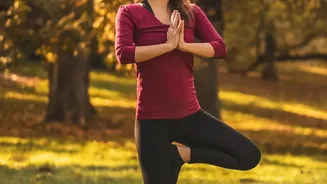
improving posture, and building a deep awareness of your body. By learning to stand with intention, you create a stable, grounded base that is essential for more challenging balance poses like Tree Pose or Warrior III. Think of it as learning the alphabet before you write a novel; Tadasana teaches you the fundamental principles of alignment and stability that carry through your entire practice and even into your daily life.
How to Find Your Mountain Pose
Finding your own strong and stable Mountain Pose is a process of mindful alignment from the ground up. Don't rush it; take your time to feel each step. 1. Start by standing with your feet either together with big toes touching or hip-width apart, whichever feels more stable for you. 2. Lift all ten of your toes, spread them wide, and then gently place them back on the mat. This helps you connect with the ground. 3. Rock your weight slightly forward and back, and side to side, until you find a point where your weight is evenly distributed across all four corners of both feet—the ball of the big toe, the ball of the little toe, and both sides of your heel. 4. Let your arms hang naturally by your sides. You can keep your palms facing your thighs or turn them forward as a gesture of openness.
Activate Your Body with Intention
Once you have your foundation, the real work of Mountain Pose begins. It is all about subtle, intentional muscle engagement. - The Legs: Engage your thigh muscles to gently lift your kneecaps, but be careful not to lock your knees. Imagine a slight inward rotation of your upper thighs. - The Core: Draw your lower abdomen in and up slightly. This supports your lower back and creates stability. Lengthen your tailbone down toward the floor to bring your pelvis into a neutral position, avoiding an excessive arch in your lower back. - The Upper Body: Broaden across your collarbones. Roll your shoulders up, back, and then let them relax down, away from your ears. Your chest should feel open, allowing for deeper breaths. - The Head and Neck: Align your ears over your shoulders, and imagine a string gently pulling the crown of your head up toward the ceiling. Keep your gaze soft and directed straight ahead.
Common Mistakes for Beginners
Even in this seemingly simple pose, a few common habits can reduce its benefits. Be mindful of these tendencies: - Locking the knees: This puts strain on the joints. Always keep a micro-bend in your knees. - Leaning your weight: Many people unconsciously lean their weight onto their heels or the inner edges of their feet. Press down firmly through all four corners of your feet. - Arching the lower back: Tucking the tailbone down too much or letting the belly push forward can strain the spine. Focus on a neutral pelvis. - Holding your breath: It is easy to hold your breath when you are concentrating. Remember to breathe deeply and steadily. Your breath is your anchor to the present moment.
Simple Balance Challenges in Tadasana
Once you feel steady in your Mountain Pose, you can use it as a laboratory to play with your balance. These small variations can dramatically improve your stability and body awareness, known as proprioception. - Close your eyes: Removing your visual reference point forces your body to rely on its internal sense of balance. You may wobble, and that's perfectly normal. Try it for a few breaths near a wall for support. - Heel lifts: Inhale as you press into the balls of your feet and lift your heels off the ground. Hold for a moment, then exhale as you slowly lower them. This strengthens your ankles and calves. - Single-leg prep: Shift your weight onto your right foot and lift your left heel, resting the toes on the floor like a kickstand. Feel the stability required on one leg, then switch sides. This is a great first step toward poses like Tree Pose. - One-legged Mountain: From a stable stance, shift your weight to one foot and slowly lift the opposite knee to hip height. Hold for a few breaths before switching sides.