
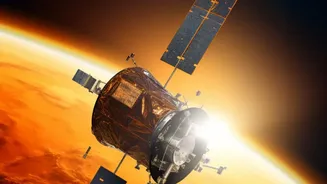

India’s Next Interplanetary Frontier
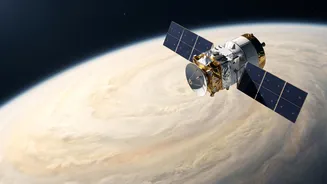
Following the historic successes of the Chandrayaan missions to the Moon and the Mangalyaan mission to Mars, the Indian Space Research Organisation (ISRO) is setting its sights on the second planet from the Sun. Officially named the Venus Orbiter Mission
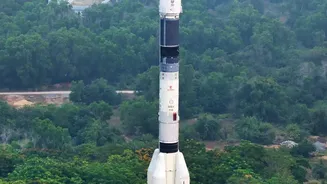
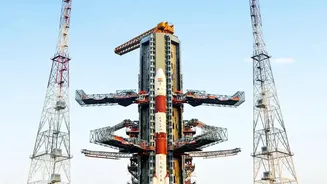
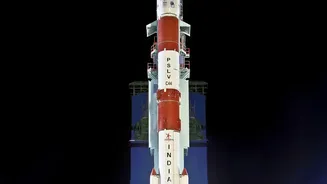
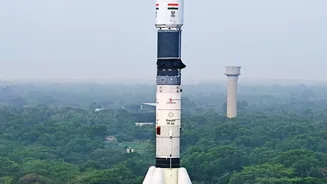
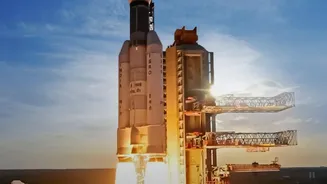
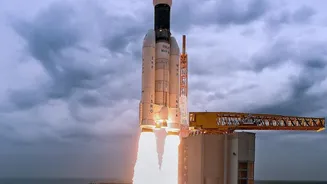
(VOM), and popularly known as Shukrayaan, this represents India's first dedicated mission to our shrouded sister planet. Approved by the Union Cabinet in September 2024, the mission is scheduled for a March 29, 2028 launch. It will be propelled into space by the powerful LVM-3 rocket, the same launch vehicle that successfully carried the Chandrayaan missions. The journey to Venus is expected to take 112 days, with the spacecraft planned to enter Venus's orbit on July 19, 2028, marking a new chapter in India’s space exploration saga.
Why Study the 'Hothouse' Planet?
Venus presents a compelling scientific puzzle. Though similar to Earth in size and mass, it evolved into a hellish world with surface temperatures hot enough to melt lead and an atmosphere 90 times denser than our own. Its skies are filled with thick clouds of sulfuric acid, and it suffers from a runaway greenhouse effect, making it the hottest planet in our solar system. Scientists believe Venus may have once had oceans and a more temperate climate. Understanding how and why it transformed so dramatically could provide crucial insights into planetary evolution, atmospheric dynamics, and climate change on our own planet. By studying Venus, ISRO hopes to unlock clues about Earth's long-term sustainability and what happens when a planet's climate goes catastrophically wrong.
The Eyes of Shukrayaan
To peer through the dense, opaque Venusian atmosphere, Shukrayaan will be equipped with a suite of approximately 19 advanced scientific instruments, or payloads, with a combined weight of about 100 kilograms. The flagship instrument is a high-resolution Synthetic Aperture Radar (SAR), which uses radar waves to map the planet's surface in unprecedented detail, regardless of cloud cover. This radar is expected to have up to four times the resolution of NASA's Magellan orbiter from the 1990s. Critically, the mission will also carry a ground-penetrating radar, making it the first mission ever to study the subsurface of Venus. This will allow scientists to investigate the planet's geological layers, searching for evidence of past activity and active volcanism.
A Mission of Global Collaboration
While Shukrayaan is an Indian-led mission, it also highlights ISRO's growing role as a leader in international space collaboration. The mission will carry payloads developed in partnership with several other nations. Russia's space agency, Roscosmos, and France's CNES are providing the VIRAL instrument to study the atmosphere. Sweden has formally joined the mission, contributing the Venusian Neutrals Analyser (VNA), an instrument designed to study how the solar wind interacts with the Venusian atmosphere. This instrument is part of a larger payload called VISWAS, a collaboration between ISRO and Sweden. Another collaborative instrument, RAVI, is being developed with Germany to analyze the planet's ionosphere. These partnerships enhance the mission's scientific capabilities and strengthen India's diplomatic ties in the space sector.
Navigating a Hostile Environment
A mission to Venus is technologically demanding. The spacecraft must not only endure the long journey through space but also operate in a harsh orbital environment. To achieve its final, low-altitude science orbit of approximately 200 by 600 kilometers, Shukrayaan will employ a technique called aerobraking for the first time in ISRO's history. Over a period of six to eight months, the orbiter will make controlled dips into the upper layers of the Venusian atmosphere, using friction to gradually slow down and lower its orbit without expending large amounts of fuel. This complex maneuver is a key technology demonstration for ISRO, paving the way for more advanced future interplanetary missions.