







A Personal, Pressurised Bubble
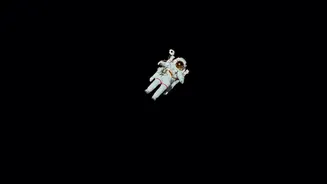
The most immediate danger in space is the vacuum. Without Earth's atmospheric pressure, the liquids in a human body would boil away at body temperature. To counteract this, a spacesuit is fundamentally a pressure vessel. An inner layer, called a pressure bladder,
is filled with oxygen to create a pressurized environment around the astronaut. This bladder is held in shape by a restraint layer, which prevents it from ballooning outwards and keeps it flexible enough for movement. This internal pressure is precisely why a good fit is critical; a poorly fitting suit would be stiff and exhausting to work in, turning simple tasks into monumental challenges.
Surviving Extreme Temperatures
Outside a spacecraft, temperatures can swing wildly, from a scorching 121°C (250°F) in direct sunlight to a bone-chilling -157°C (-250°F) in the shade. A spacesuit must act as a perfect insulator. This is achieved with multiple layers of Mylar—a material similar to that found in a thermos—sandwiched with spacer fabrics. However, the real challenge is often getting rid of heat. An astronaut's body generates significant heat while working, which gets trapped by the suit's insulation. To solve this, astronauts wear a Liquid Cooling and Ventilation Garment (LCVG) underneath everything. This snug, full-body garment has about 91 metres (300 feet) of thin tubes woven into it, circulating cool water to draw heat away from the body.
Providing Every Single Breath
The backpack, officially known as the Portable Life Support System (PLSS), is the suit's engine room. It contains tanks of pure oxygen for the astronaut to breathe, which is also what pressurizes the suit. Just as important, it removes the carbon dioxide the astronaut exhales, using special filter canisters. Without this CO2 removal, the air inside the helmet would quickly become toxic. The PLSS also holds the water for the cooling garment, a pump to circulate it, a battery for electrical power, and the two-way radio for communication with Mission Control and other crew members.
A Shield Against Invisible Dangers
Space is not completely empty. It’s filled with invisible radiation and tiny, fast-moving particles called micrometeoroids. While a spacesuit offers limited protection against major solar radiation events, its outer layers are designed to handle the constant low-level threat. The Thermal Micrometeoroid Garment is the suit's outer shell, composed of up to 14 layers of incredibly tough, specialised fabrics like Kevlar, Nomex, and Gore-Tex. These layers are designed to break up and stop tiny debris particles that travel many times faster than a bullet, which could otherwise puncture the pressure bladder. The helmet's visor even has a thin, gold-lined layer that acts like a powerful pair of sunglasses, reflecting harmful solar radiation.
Why 'One Size Fits All' Fails
While early Apollo suits were entirely custom-made for each astronaut, modern suits like the Extravehicular Mobility Unit (EMU) used on the International Space Station are more modular. They consist of interchangeable parts—upper torsos, arms, and legs of different sizes—that are assembled to best fit each individual. However, a perfect fit remains paramount. Gloves, in particular, are often custom-fitted to ensure astronauts have enough dexterity to handle tools and perform delicate repairs. A poorly fitted suit can cause fatigue, limit mobility, and even lead to injuries. As NASA and its commercial partners design the next generation of suits for missions to the Moon and Mars, they are focusing on even greater mobility and accommodating a wider range of astronaut body types, ensuring everyone can work safely and efficiently on alien worlds.