





From Fossil to Fact
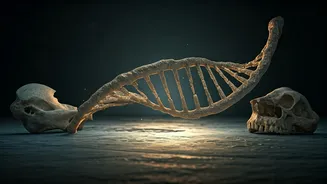
The science of ancient DNA (aDNA) analysis is like a high-tech form of archaeology, but instead of digging for pottery, scientists are hunting for genetic fragments. The process is incredibly delicate. DNA is a fragile molecule that begins to break down
after an organism dies. Heat, moisture, and microbes all take their toll, leaving researchers with a tiny, shattered puzzle to solve. To even begin, scientists work in ultra-clean laboratories, often wearing full-body sterile suits to avoid contaminating the precious samples with their own DNA. They typically drill into the densest parts of bone, like the petrous bone in the skull, which can preserve DNA for thousands of years. From this bone powder, they extract what little genetic material is left. Because the DNA is so fragmented, powerful computers are then used to painstakingly stitch these short pieces together, comparing them to known genomes to reconstruct a profile of an individual who lived tens of thousands of years ago.
Rewriting the Human Story
This technology has fundamentally changed our understanding of human origins. For years, the prevailing theory was that modern humans simply replaced the Neanderthals as they spread out of Africa. However, the pioneering work of scientists like Nobel laureate Svante Pääbo proved this was not the case. By successfully sequencing the Neanderthal genome, his team made a stunning discovery: most modern humans living outside of Africa carry around 2% Neanderthal DNA. This was concrete proof that our ancestors didn't just outcompete their archaic relatives—they interbred with them. This finding transformed our family tree from a simple branching diagram into a complex, interconnected web. It revealed a past filled not with rigid separation, but with migration and mixing between different human groups, including another mysterious lineage known as the Denisovans, who were themselves discovered entirely through aDNA from a tiny finger bone found in a Siberian cave.
Solving India's Ancient Puzzles
The power of aDNA is also being applied to uncover the history of the Indian subcontinent. A major breakthrough came from the analysis of remains found at Rakhigarhi, one of the largest cities of the Indus Valley Civilisation, located in modern-day Haryana. For decades, the origins of the Harappan people and their relationship to modern Indians were debated. After screening dozens of skeletons, researchers managed to sequence the genome of a woman who lived there around 4,500 years ago. The results were transformative. Her DNA showed no trace of ancestry from the Steppe pastoralists of Central Asia, challenging long-held theories about large-scale migrations into the region during the civilisation's peak. Instead, her genetic makeup showed a mix of ancestry related to ancient Iranians and indigenous South Asian hunter-gatherers, a profile that forms the primary foundation for most modern-day South Asians. This provided direct evidence for a deep ancestral continuity in the region.
The Future of the Past
The field of aDNA is moving at a breathtaking pace. Scientists are no longer limited to bones and teeth; they can now extract genetic material from soil, dental calculus, and even parchment from ancient manuscripts. This opens up a world of possibilities. Researchers can now track the evolution of pathogens, like the bacteria that caused the Black Death, by finding its DNA in the teeth of plague victims. They can understand how ancient populations adapted to new diets and climates, and map the domestication of important plants and animals. Of course, there are limits. DNA degrades faster in warm, humid climates, which makes recovering samples from many parts of the world, including much of India, exceptionally difficult. Yet, as technology improves, scientists are getting better at reading these faint genetic whispers from the past. Each successfully sequenced genome adds a new character to the story of humanity, a story that we are only just beginning to read in full.