
The Technique: Transmission Spectroscopy
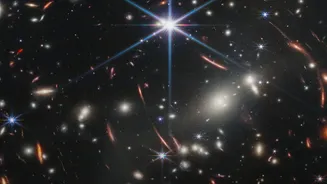
The primary method the JWST uses to detect atmospheric components like water is called transmission spectroscopy. While the headline mentions 'deep-field scans,' which are broad surveys of distant galaxies, finding water on an exoplanet requires a more
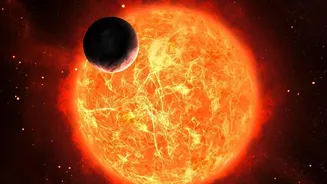
focused approach. Scientists first identify a star that has a planet known to pass in front of it, or 'transit,' from our point of view. Then, the telescope stares intently at that star and waits for the planet to make its pass. This is less like a scan and more like a stakeout, gathering every possible photon of light.
Filtering Starlight Through an Alien Sky
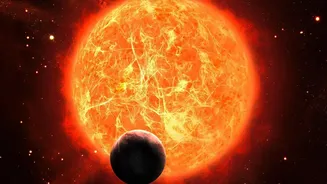
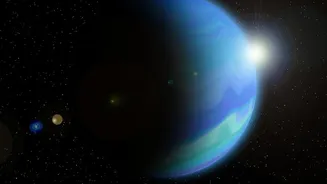
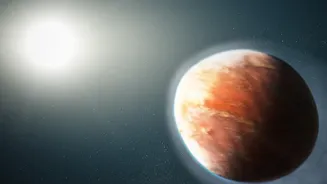
As the exoplanet crosses in front of its host star, a tiny fraction of the starlight filters through the planet's atmosphere before continuing on its journey to the JWST's mirrors. While the planet itself blocks most of the light, this thin, backlit halo of gas contains a treasure trove of information. The gases and chemicals in the atmosphere absorb some of the starlight, but they don't do so randomly. This is the critical moment of detection.
The Chemical 'Fingerprint' of Water
Every molecule absorbs very specific wavelengths, or colours, of light. You can think of it as a unique chemical 'barcode' or 'fingerprint'. Water vapour, for example, is known to absorb light very strongly in specific parts of the infrared spectrum. By splitting the starlight into its full spectrum of colours, like a rainbow, astronomers can look for the tell-tale dark lines where light is missing. If they see a pattern of missing light that perfectly matches the known absorption fingerprint of water, they can confidently say water vapour is present in that alien atmosphere.
Webb's Infrared Superpower
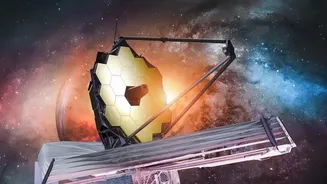
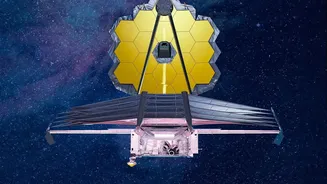
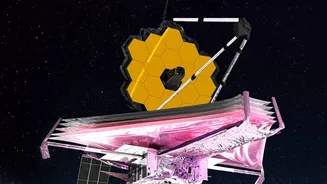
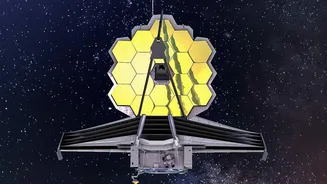
This is where the James Webb Space Telescope's design is revolutionary. Previous telescopes like Hubble could perform some transmission spectroscopy, but JWST is specifically optimised to see in infrared light, where the absorption signatures for molecules like water, methane, and carbon dioxide are strongest and clearest. Its massive mirror allows it to collect more light with greater sensitivity than ever before, and its specialised instruments, like the Near-Infrared Spectrograph (NIRSpec) and the Mid-Infrared Instrument (MIRI), are designed to precisely measure these chemical fingerprints. This allows scientists not only to detect water but to begin to estimate its abundance.
From Data to Discovery in Action
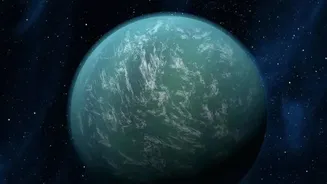
This method has already yielded incredible results. In one of its first major observations, JWST delivered a detailed spectrum from the gas giant WASP-96 b, showing the unambiguous signature of water. Since then, it has detected water vapour in the atmospheres of numerous other exoplanets, including the fascinating case of WASP-107b, where it found not only water vapour but also sulfur dioxide and clouds made of sand-like silicate particles. More recently, it detected water in the inner, rocky-planet-forming zone of the young star system PDS 70, suggesting that the raw materials for life could be available to new planets from the very beginning. These discoveries are transforming our understanding of planetary formation and the variety of worlds that exist in our galaxy.