



Why Your Desk Job Is Causing Aches
Our bodies are designed for movement, but modern work often forces us into a static, seated position for hours. This prolonged sitting causes several problems. The muscles at the front of your hips, known as hip flexors, become short and tight, which
can pull your pelvis forward and strain your lower back. Meanwhile, your glute muscles can weaken from inactivity. More importantly, the natural curves of your spine are compromised. Many people adopt a slouched posture with a rounded upper back and forward head position. Over time, this limits the mobility of your thoracic spine (mid-back), forcing your neck and lower back to compensate, which often leads to stiffness, tension, and pain.
Minutes 0–2: Cat-Cow Stretch
This classic yoga-inspired movement is one of the best ways to gently warm up the spine and improve its flexibility. It encourages movement through each vertebra, increases blood circulation, and helps release tension in the neck and back. How to do it: Start on all fours with your wrists under your shoulders and knees under your hips. Inhale as you drop your belly, lift your chest, and look slightly forward, creating an arch in your back (Cow Pose). Exhale as you press into your hands, round your spine toward the ceiling, and tuck your chin to your chest (Cat Pose). Continue flowing between these two poses for two minutes, synchronizing the movement with your breath.
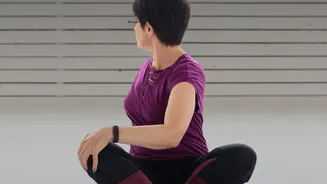
Minutes 2–4: Seated Spinal Twists
Rotation is a key movement for spinal health that is often neglected during the workday. Seated twists help restore this rotational mobility, especially in the thoracic spine, which can become very stiff from hunching over a computer. This helps relieve upper back tension and improve your overall posture. How to do it: Sit tall in your chair with your feet flat on the floor. Cross your arms over your chest or place your left hand on your right thigh. Gently twist your upper body to the right, keeping your hips facing forward. Hold for 15-20 seconds, breathing deeply. Return to the center and repeat on the left side. Continue alternating sides for two minutes.
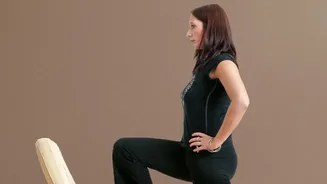
Minutes 4–7: Seated Pigeon Pose (Figure-4 Stretch)
This stretch is a fantastic hip opener that you can do right from your chair. It targets the glutes and the piriformis muscle, which can become tight from sitting and contribute to hip and lower back pain. It's an accessible alternative to the floor-based pigeon pose and is highly effective at releasing deep-seated tension. How to do it: While seated, cross your right ankle over your left thigh, just above the knee, creating a 'figure 4' shape. Keep your right foot flexed to protect the knee. Sit up tall to lengthen your spine. If you feel a good stretch here, hold this position. For a deeper stretch, gently hinge forward at your hips, keeping your back straight, until you feel a comfortable stretch in your right hip and glute. Hold for 60-90 seconds, then switch sides.
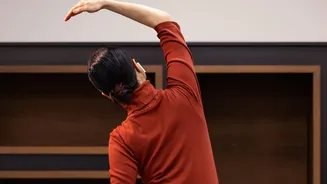
Minutes 7–9: Thoracic Extensions Over a Chair
This drill directly counteracts the slumped, rounded posture many of us adopt at our desks. It focuses on extending the thoracic spine, helping to open up the chest and relieve stiffness in the upper back. Improving this extension is crucial for better posture and reducing strain on your neck and shoulders. How to do it: Sit toward the front of your chair. Clasp your hands behind your head to support your neck. Gently arch your upper back over the top of the chair, allowing your chest to open up and your head to move back. Look up toward the ceiling. Hold for a few seconds, then return to a neutral position. Repeat this movement slowly and with control for two minutes, focusing on breathing into your chest as you extend back.
Minutes 9–10: Deep Breathing and Posture Reset
Finish your routine with one minute of mindful breathing to calm your nervous system and lock in your new, more open posture. Proper breathing mechanics are closely tied to spinal health. How to do it: Sit tall in your chair, feet flat on the floor. Pull your shoulders back and down. Place one hand on your chest and the other on your belly. Inhale slowly and deeply through your nose, feeling your belly expand. Exhale slowly through your mouth. Focus on maintaining this tall, aligned posture as you breathe. This simple act reinforces the postural awareness you've just cultivated.