


Sailing on Beams of Light
For decades, space exploration has been defined by the brute force of chemical rockets, which provide an immense initial push but are ultimately limited by the amount of fuel they can carry. This constraint makes long-distance voyages incredibly complex
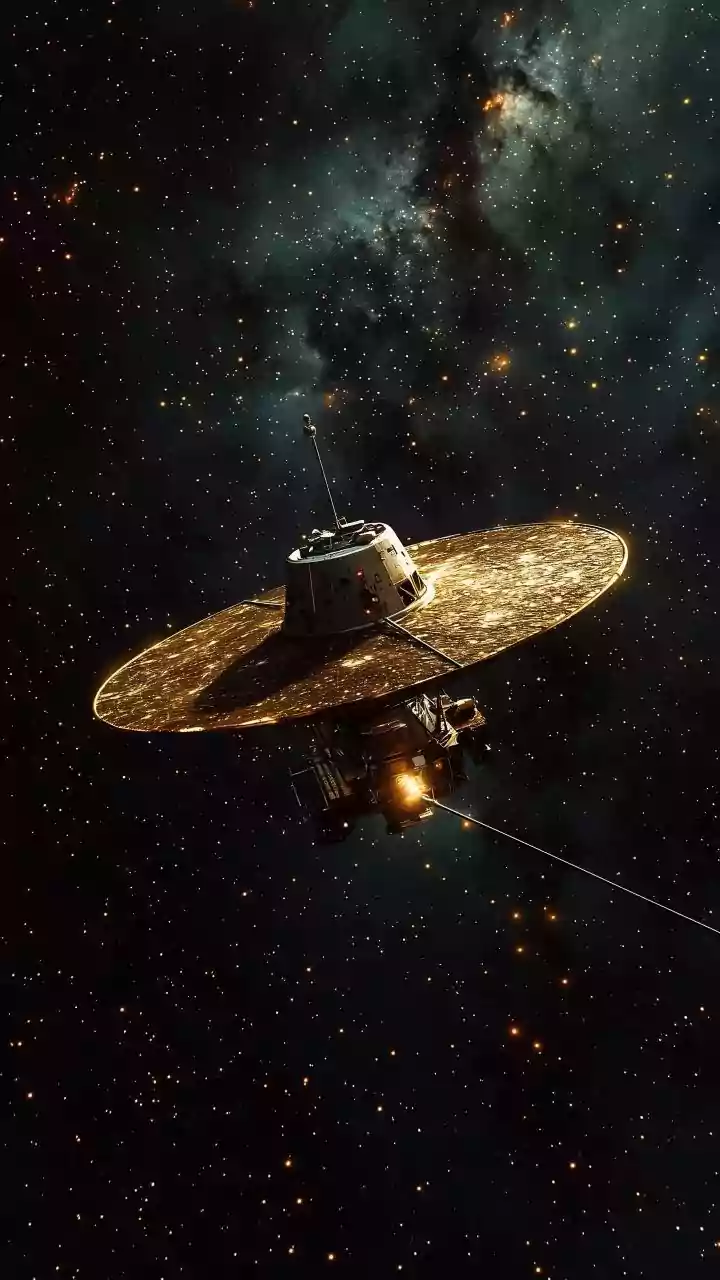
and expensive. Solar sails offer an elegant alternative, functioning much like a sailboat on water, but with a crucial difference: the 'wind' is sunlight itself. A solar sail spacecraft deploys a vast, ultra-thin, reflective sheet to catch the momentum of photons—particles of light—streaming from the sun. While this 'solar wind' of photons is distinct from the solar wind of charged particles, its effect is powerful over time. The concept, first imagined by Johannes Kepler in the 17th century, is now a cornerstone of next-generation space travel.
The Physics of a Photon's Push
How can light, which has no mass, push a spacecraft? The answer lies in the fundamental principles of physics. While photons are massless, they possess both energy and momentum. When a photon strikes the mirror-like surface of a solar sail, it transfers its momentum to the sail, giving it a tiny push. Because the sail is highly reflective, the photon then bounces off, imparting a second, equally tiny push in the process, much like a ball bouncing off a wall. This phenomenon is known as radiation pressure. While the force from a single photon is minuscule, the sun emits a constant, overwhelming stream of them. In the friction-free vacuum of space, the cumulative effect of these countless tiny pushes results in continuous, gradual acceleration.
The Advantage of Endless Acceleration
Unlike a conventional rocket that coasts after its initial fuel burn, a solar sail-powered craft accelerates continuously as long as it is exposed to sunlight. This slow-but-steady approach is a game-changer for deep-space missions. Over weeks, months, and years, a solar sail can achieve speeds far greater than what is possible with a fuel-limited spacecraft. This capability dramatically shortens travel times to the outer solar system and beyond, all without carrying heavy propellant. By simply changing the angle of the sail relative to the sun, a spacecraft can 'tack' through the solar system, steering and adjusting its trajectory to reach distant planets, asteroids, or even leave our solar system entirely.
From Theory to Reality: Missions in Flight
Solar sailing is no longer just a theoretical concept. Several missions have successfully demonstrated its viability. Japan's IKAROS, launched in 2010, was the first spacecraft to successfully use solar sailing for propulsion in interplanetary space. More recently, The Planetary Society's crowdfunded LightSail 2 mission, which concluded in 2022, proved that a small satellite could use a solar sail to raise its orbit around Earth, a major milestone for the technology. Building on these successes, NASA launched its Advanced Composite Solar Sail System (ACS3) in 2024 to test new, lightweight composite booms and a large 80-square-meter sail, paving the way for even bigger and more ambitious missions.
Challenges and the Future Horizon
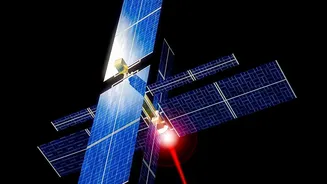
Despite its immense potential, solar sail technology faces engineering challenges. The sails must be enormous—sometimes the size of a basketball court or larger—yet incredibly light and durable to withstand the harsh space environment. Deploying these gossamer-thin structures from a compact spacecraft is a high-stakes, complex maneuver. Furthermore, the push from sunlight weakens significantly as the spacecraft travels farther from the sun, limiting acceleration in the outer solar system. Future innovations aim to address these issues, with some concepts exploring the use of powerful ground-based lasers to propel sails on interstellar journeys, freeing them from reliance on the sun.