





The Map and Compass Model
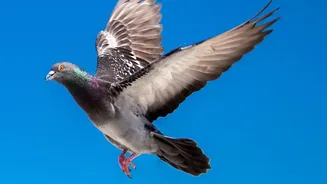
For decades, scientists have been fascinated by how pigeons perform these incredible journeys. The leading framework is a 'map and compass' model. The 'compass' helps a bird get its bearings and determine which way is north, south, east, or west. The 'map'
is what allows it to determine its position relative to its home. Imagine being dropped in an unknown city. A compass tells you which way is north, but it doesn't tell you whether your home is to the north, south, east, or west. For that, you need a map. Pigeons have both, but their versions are far more complex and innate than the tools a person might use. They don't rely on a single sense, but rather a combination of environmental clues.
A Built-In Magnetic Sense
One of the most studied of these tools is magnetoception—the ability to perceive the Earth's magnetic field. This sense acts as a reliable backup compass, especially on overcast days when other cues are unavailable. Scientists have long debated how this works. One theory proposed that pigeons have tiny iron particles, specifically magnetite, in their beaks that act like microscopic compass needles. However, later research has cast doubt on this, suggesting that the cells containing these particles were actually immune cells called macrophages, not neurons. Another compelling theory involves proteins in the pigeon's retina called cryptochromes. This model suggests the birds might be able to 'see' the magnetic field, a light-dependent sense that would give them a visual direction to follow. Recent studies have even pointed to immune cells in the liver as a potential source of this magnetic sense. While the exact mechanism is still being investigated, the existence of this internal compass is well-established.
Navigating by the Sun
On clear days, the primary compass for a pigeon is the sun. Like ancient sailors, pigeons use the sun's position in the sky to determine their direction of flight. But this requires more than just seeing the sun; it requires an incredibly accurate internal clock. To use the sun for navigation, a bird must know the time of day to compensate for the sun's movement across the sky. Scientists have proven this through 'clock-shift' experiments. Pigeons kept in artificial light conditions that shift their internal sense of time will fly in a predictably wrong direction when released, because their interpretation of the sun's position is incorrect. This indicates that the sun compass is not just a casual observation but a precise calculation.
The Surprising Power of Smell
Perhaps one of the most surprising navigational tools is the pigeon's sense of smell. Research suggests that pigeons create 'olfactory maps' of their surroundings. There are two main ideas for how this works. The 'mosaic' model suggests pigeons learn a patchwork of distinct smells—a pine forest here, a coastline there—and recognise these familiar scents to get their bearings. The more ambitious 'gradient' model proposes that pigeons can detect subtle, stable gradients of smells in the atmosphere that change over large distances. By learning the specific smells carried on the wind at their home loft, they can determine their direction of displacement by what they smell at a release site. Experiments have shown that pigeons with an impaired sense of smell struggle to home from unfamiliar locations, giving strong support to the importance of olfactory cues.
Soundscapes and Familiar Sights
Beyond magnetism, sun, and smell, pigeons employ even more senses. Some research indicates they can hear very low-frequency sounds, known as infrasound. These sound waves, inaudible to humans, are generated by things like ocean waves crashing and wind moving over terrain. Because local topography creates a unique infrasonic signature, pigeons may create an 'acoustic map' of the world. This might explain why their navigation can sometimes be disrupted by sources of infrasound, such as supersonic jets. Finally, as they get closer to home, pigeons rely heavily on visual landmarks. Just like humans, they recognise roads, rivers, and buildings to fine-tune the last leg of their journey, often following habitual routes they've learned over many flights.