


Visitors on a One-Way Ticket
Everything you've ever seen in the night sky—planets, asteroids, comets—is gravitationally bound to our Sun. They are part of our local family, stuck in predictable orbits. An interstellar object, however, is a tourist. It’s a comet or asteroid that formed
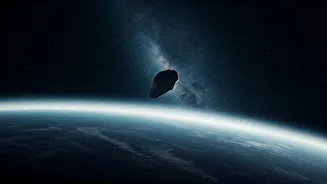
around another star, was somehow ejected, and has been wandering through the Milky Way for millions, or even billions, of years. Its path through our solar system is a hyperbolic trajectory, meaning it’s moving too fast for the Sun's gravity to capture it. It comes in for a brief, high-speed visit and then heads back out into the void, never to return. For a long time, these were purely theoretical. Now, we know they are real.
The First Messenger: ‘Oumuamua
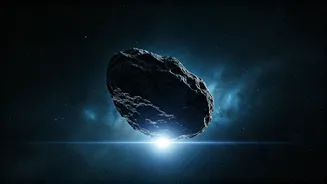
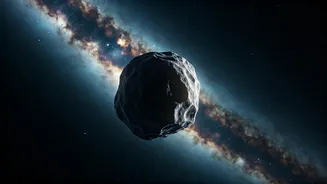
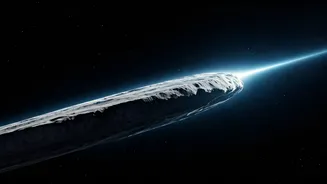
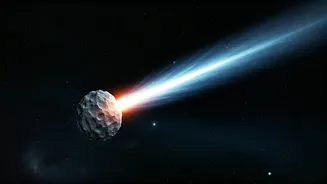
In 2017, astronomers at the Pan-STARRS observatory in Hawaii spotted something unprecedented: the first confirmed interstellar object, named 1I/‘Oumuamua, a Hawaiian word meaning “a messenger from afar arriving first”. And it was weird. Observations suggested it was a highly elongated, cigar-shaped object, maybe ten times longer than it was wide, with a reddish hue. Unlike a typical comet, it had no visible tail of gas and dust, even as it sped past the Sun. Its slight acceleration, which wasn't caused by gravity, puzzled scientists, leading to wide-ranging speculation. While some theories proposed it could be a piece of a Pluto-like planet from another system, its true nature remains a captivating mystery.
A More Familiar Guest: 2I/Borisov
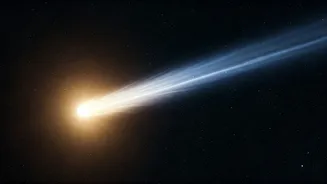
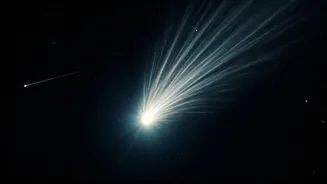
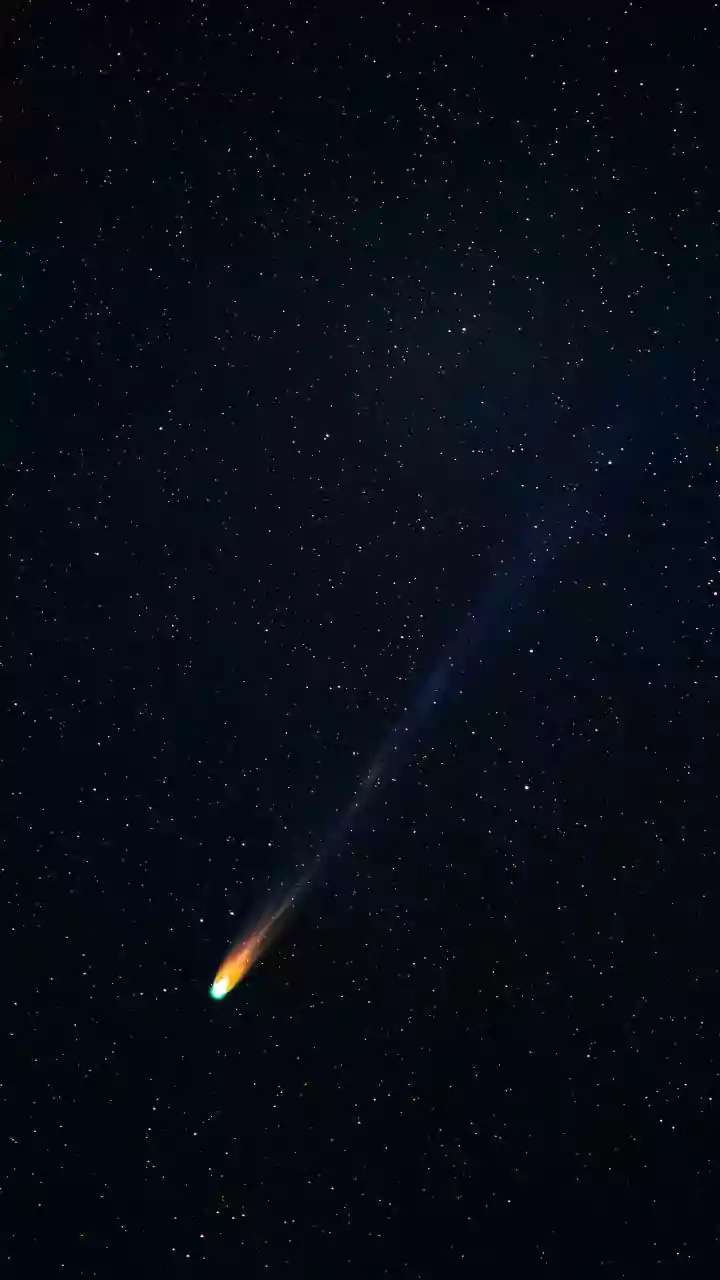
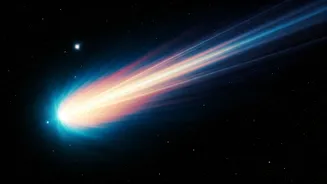
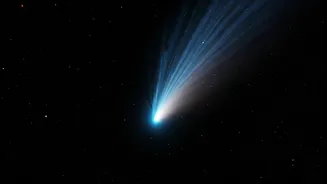
Just two years later, in 2019, amateur astronomer Gennadiy Borisov discovered our second interstellar visitor. This one, 2I/Borisov, was much more familiar. It looked and acted like a comet from our own solar system, developing a classic coma and tail as it was warmed by the Sun. Observations showed its composition was similar to our own comets, though with some key differences, like a much higher concentration of carbon monoxide. Scientists believe Borisov may have been a pristine relic that had never passed close to any star before visiting ours, making it an undisturbed sample from the cloud of gas and dust where it formed.
Connecting the Star Systems
The existence of ‘Oumuamua and Borisov does more than just prove we get cosmic visitors. It shrinks the galaxy. These objects demonstrate that the raw materials that build planets are not confined to their home systems. They can be ejected and travel across interstellar space. It means our solar system is part of a much larger, dynamic galactic ecosystem where matter is exchanged between stars. Each visitor is a physical sample from another planetary system, a time capsule carrying chemical fingerprints of an alien world. They offer clues about how planets form and evolve elsewhere in the Milky Way, something we could previously only study by observing light from distant stars.
A Flood of New Discoveries
Finding two interstellar objects was just the beginning. The discovery of a third, 3I/ATLAS, in 2025 confirmed that these visitors might be more common than we thought. Our ability to spot these faint, fast-moving objects has rapidly improved. The Vera C. Rubin Observatory, which began its official sky survey in mid-2026, is poised to revolutionize the field. With its powerful camera and wide field of view, the observatory is expected to detect dozens of interstellar objects every year, turning them from once-in-a-lifetime oddities into a regular stream of data. This will allow for the first population studies of these objects, revealing how common they are and what they can collectively teach us about the galaxy's history.