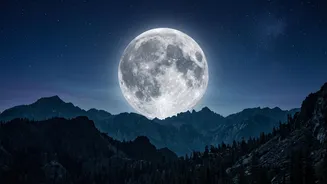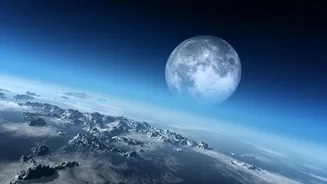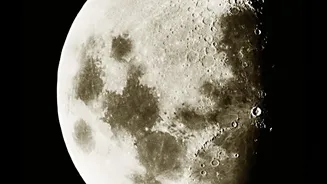




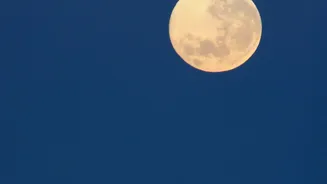
It’s a sight that has captivated humanity for millennia: a colossal, golden moon hanging just above the horizon. But here's the secret: it's all in your head. The Moon Illusion is one of nature's greatest magic tricks, rooted in perception, not physics.
An Illusion Everyone Has Seen
First, let's get one thing straight: the moon doesn't actually change size. If you were to take a picture of the moon near the horizon and another hours later when it's high in the sky, using the same camera settings, you'd find its diameter is virtually identical in both photos. In fact, the moon is technically about 1.5% farther away from you when it's on the horizon, meaning it should appear slightly smaller, not larger. The dramatic size difference you perceive is a powerful and convincing illusion created entirely by your brain as it tries to make sense of the visual information it receives. The atmosphere can change the moon's color to yellow or red and slightly flatten its shape, but it doesn't magnify it. The size change is purely a trick of the mind.
The Brain's Old Programming
The leading explanation for this phenomenon is the 'Apparent Distance Hypothesis', an idea that dates back to ancient times. This theory suggests our brains are hardwired to perceive the sky not as a perfect half-dome, but as a flattened bowl. Think about your everyday experience: clouds, birds, and airplanes look far away when they're on the horizon and much closer when they're directly overhead. Your brain has learned this rule and applies it to everything in the sky. When the moon is on the horizon, your brain automatically assumes it's much farther away than when it's high in the sky. Since its size on your retina doesn't change, your brain 'corrects' for the perceived extra distance by making the moon seem enormous.
A Cosmic Ponzo Illusion
This mental scaling trick is similar to a classic optical illusion called the Ponzo Illusion. Imagine two identical lines drawn across a set of converging railroad tracks. The line drawn where the tracks are 'farther' away will appear much longer than the line where the tracks are 'closer', even though they are the same length. Your brain uses the converging lines as depth cues and scales up the size of the 'distant' line. The Moon Illusion works on a similar principle. When the moon is low, the landscape—trees, buildings, and the texture of the ground—provides a rich set of perspective cues that make the moon seem very far away. Your brain, following the Ponzo logic, inflates the moon's size to match this perceived distance. When the moon is high in the empty night sky, there are no such depth cues, so your brain perceives it as closer and, therefore, smaller.
The Power of Comparison
Another related factor is the presence of foreground objects. Our brains are constantly judging the size of things relative to other objects in our view. When the moon appears behind a distant mountain, nestled between city skyscrapers, or tangled in the branches of a tree, your brain has familiar objects to compare it with. Next to a tiny-looking tree on the horizon, the moon appears gigantic by comparison. This is known as the Ebbinghaus illusion, where an object appears larger when surrounded by smaller objects. High in the sky, the moon is surrounded only by the vast, empty expanse of space. Without any points of reference for scale, it appears more isolated and, to our brains, smaller. Some fMRI studies have even shown that specific areas of the brain's visual pathway become more active when we perceive this illusory size increase, showing how deeply this process is embedded in our neural wiring.
Can You Break the Spell?
Because the Moon Illusion is a cognitive trick, you can actually 'break' it with a few simple experiments of your own. The next time you see a giant moon on the horizon, try looking at it through a paper tube or a loosely curled fist. This simple act removes the surrounding landscape from your field of view, and the moon will instantly appear to shrink back to its 'normal' size. Another popular, if slightly silly, method is to bend over and look at any moon from between your legs. This disorients your brain's usual up/down spatial processing, disrupting any illusion and revealing its true size. These tricks prove that its majestic size isn’t out there in space but inside your head.