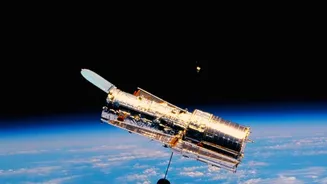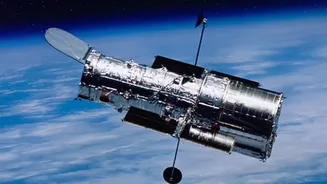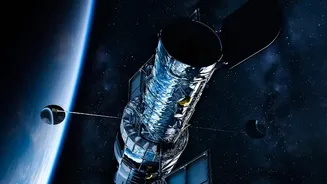





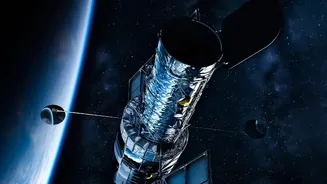
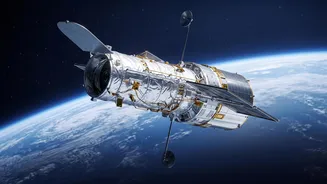
For over three decades, the Hubble Space Telescope has been humanity's eye into the cosmos. But now, its mission is in jeopardy. In an unprecedented move, NASA is turning to the private sector for a potential rescue.
An Icon Facing a Slow Descent
The Hubble Space Telescope is more
than just a scientific instrument; it's a cultural icon that has fundamentally changed our view of the universe. Since its launch in 1990, it has delivered breathtaking images and groundbreaking discoveries. But like all spacecraft in low Earth orbit, Hubble is slowly but surely being dragged down by Earth's atmosphere. Without a propulsion system of its own, its orbit has been steadily decaying. The last time it received a boost was from the Space Shuttle Columbia in 2002. With the shuttle fleet now retired, NASA predicts that without intervention, Hubble will make an uncontrolled reentry into the atmosphere sometime between 2033 and 2034.
A Call for Commercial Solutions
Recognizing the urgency, NASA has issued a formal 'Request for Information' (RFI) to the commercial space industry. This isn't a contract, but a market survey to see what's possible. The agency has laid out three potential paths for private companies: boost Hubble to a higher, more stable orbit; service the telescope to enhance its performance; or, as a last resort, guide it to a safe, controlled deorbit over an unpopulated area of the ocean. To extend its life, any reboost mission would need to lift the observatory to an altitude of at least 600 kilometers by a target date of 2032. This move signals a major shift for NASA, which is now looking at commercial capabilities that have 'rapidly evolved' in recent years.
The Rise of Private Spaceflight
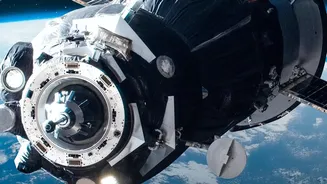
So, who could answer NASA's call? The most prominent name is SpaceX. The company, in partnership with the Polaris Program led by billionaire Jared Isaacman, previously conducted a six-month feasibility study with NASA to explore using a Dragon spacecraft for just such a mission. That study, initiated in 2022, was designed to understand the technical challenges of docking with and moving the telescope. While the full results haven't been released, the groundwork has been laid. Other companies with expertise in in-orbit servicing, like Northrop Grumman and Rocket Lab, are also seen as potential contenders. The company that takes on the task would be responsible for the entire operation, from the launch vehicle to the mission control, and even the crew, if the proposed solution involves astronauts.
More Than Just a Boost
While orbital decay is the long term threat, Hubble also faces more immediate hardware issues. The telescope relies on gyroscopes to point with incredible precision, and these components wear out over time. Astronauts last replaced all six gyros in 2009, but several have since failed. While engineers have developed clever ways for Hubble to operate on fewer gyros, its capabilities are compromised. A potential servicing mission could address these hardware problems in addition to providing an orbital boost. Saving Hubble is scientifically crucial because its unique ability to observe in ultraviolet and visible light isn't replicated by newer observatories like the James Webb Space Telescope, which primarily sees in infrared. Extending Hubble’s life would bridge a potential data gap until its successor, the Habitable Worlds Observatory, is launched in the 2040s.
A New Business Model for the Final Frontier
This request from NASA is more than just an attempt to save a beloved telescope. It represents a new business model for space exploration. With government budgets constrained and the private sector's capabilities soaring, public–private partnerships are becoming essential. NASA is transitioning from an agency that does everything itself to one that acts as a customer, purchasing services from commercial providers. As NASA Administrator Jared Isaacman noted, the agency owes it to taxpayers and the scientific community to explore 'innovative and cost–effective ways' to extend the life of valuable assets already in orbit. The mission to save Hubble, should it happen, could become the blueprint for how legacy satellites and future space infrastructure are maintained for decades to come.