






An Annual Environmental Crisis
The end of the harvest season in states like Punjab and Haryana has become synonymous with a public health emergency. To quickly clear their fields for the next crop, farmers resort to burning millions of tonnes of paddy stubble. This practice releases
vast plumes of smoke containing harmful pollutants, contributing significantly to the severe air pollution that blankets Delhi and the National Capital Region each winter. For farmers, burning is often the only economically viable option to deal with the massive volume of agricultural residue left behind by mechanical harvesters. This cycle of burning not only degrades air quality but also depletes the soil of essential nutrients, creating a complex environmental and agricultural challenge that demands an innovative solution.
Nature’s Unseen Engineer: Mycelium
The answer to this man-made problem may lie in one of nature's most efficient engineers: mycelium. Mycelium is the intricate, thread-like root network of fungi that grows underground. Think of it as the root system of a mushroom. In its natural environment, mycelium acts as a powerful binding agent, weaving through soil and decaying organic matter to hold it together. Innovators realised that this natural glue could be directed. By providing it with a food source—in this case, agricultural waste—mycelium can be grown to create solid, composite materials. It is a biological process that requires minimal energy and turns low-value biomass into something structured and useful.
The Bio-Fabrication Process
The transformation from crop waste to a finished product is a fascinating example of biotechnology at work. First, agricultural residues like rice straw or sugarcane bagasse are collected, sterilised to remove any competing microbes, and then inoculated with a specific strain of mycelium. This mixture is placed into moulds of a desired shape—perhaps a block for insulation or a custom form for protective packaging. Over several days, in a controlled, humid environment, the mycelium feeds on the waste, growing a dense network of fibres that binds the loose particles together. Once the material has solidified, it is heat-treated. This final step deactivates the fungus to stop its growth and solidifies the structure, resulting in a material that is surprisingly lightweight yet durable.
India's Mycelium Pioneers
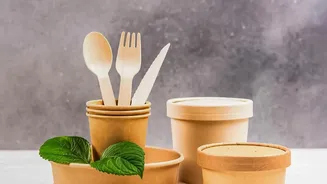
Several Indian startups are at the forefront of this green-tech revolution. Dharaksha Ecosolutions, based in Faridabad, was co-founded by Arpit Dhupar, who was motivated to find a solution after seeing the grey skies caused by stubble burning. The company sources paddy stubble directly from farmers—providing them with an alternative income—and uses mycelium to create biodegradable packaging that serves as a direct replacement for thermocol (polystyrene). Similarly, Pune-based Roha Biotech is developing mycelium composites for both packaging and construction applications. Other ventures like Mycocycle in Bangalore are exploring different feedstocks such as banana stems, while STEMPACK in Kerala is also focused on creating thermocol alternatives from local agricultural waste.
Bricks and Panels Grown From Fungi
While packaging is a major focus, the potential applications extend deep into the construction industry, as the headline suggests. Mycelium composites have excellent properties for building materials. They are naturally fire-resistant, water-resistant, and provide fantastic thermal and acoustic insulation. These 'myco-materials' can be formed into panels for walls, insulation boards, and even bricks. These materials are not just sustainable in their production; they are also fully biodegradable at the end of their life, composting back into the soil without leaving toxic residue. An architectural installation in Kerala has already showcased how mycelium can be used to create temporary event structures, highlighting its versatility and eco-friendly credentials.
Building a Circular Economy
The rise of mycelium technology represents more than just a new material; it's a blueprint for a circular economy. It’s a 'waste-to-wealth' model that addresses multiple problems simultaneously. It mitigates air pollution, reduces our reliance on single-use plastics and foams, lowers the carbon footprint of the construction industry, and provides a new revenue stream for farmers. By creating value from something that was previously discarded or burned, these startups are proving that environmental solutions can also be economically sound. This approach doesn't just clean up waste; it prevents it from becoming a problem in the first place, building local industries that are sustainable by design.