




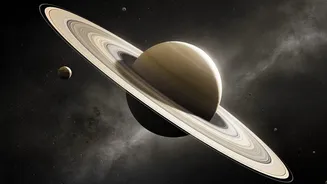
An Enduring Cosmic Question
For as long as we have been able to see them, the origin of Saturn's rings has been a source of intense debate. Early astronomers like Galileo Galilei first observed them in 1610, though he couldn't discern their true nature. It was Christiaan Huygens
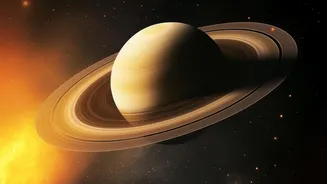
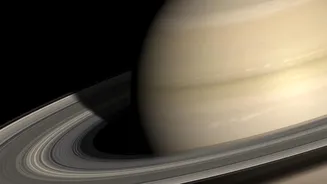
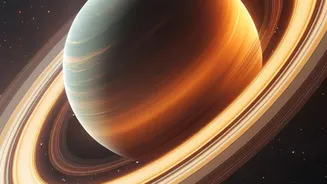
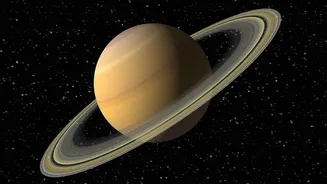
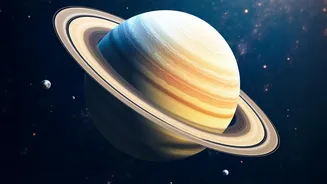
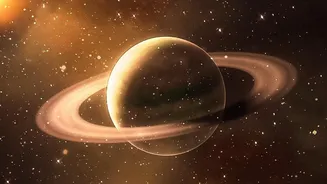
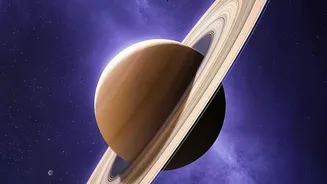
in 1655 who correctly described them as a disk surrounding the planet. Since then, the central question has been whether these spectacular structures are as old as Saturn itself, dating back 4.5 billion years, or if they are a much more recent cosmic addition. The answer holds clues not just about Saturn, but about the chaotic and dynamic history of our entire solar system. The rings are primarily made of water ice, with particles ranging from the size of sand grains to massive, mountain-sized boulders. This composition is a key piece of the puzzle that astronomers are trying to fit together.
The Case for Young Rings
A wealth of data from NASA's Cassini mission, which orbited Saturn from 2004 to 2017, has strongly suggested that the rings are surprisingly young. Findings indicate they may have formed between just 10 and 100 million years ago, meaning they appeared during the age of the dinosaurs. This theory is based on two main lines of evidence. First, scientists measured the mass of the rings during Cassini's final orbits and found them to be less massive than some models of ancient rings would predict. Second, the rings are remarkably clean and bright. If they were billions of years old, they should be much darker and dirtier, having been polluted by a constant rain of interplanetary dust over eons. The apparent youth of the rings has led to theories that they must have been formed by a dramatic, recent event.
A Lost Moon Named Chrysalis?
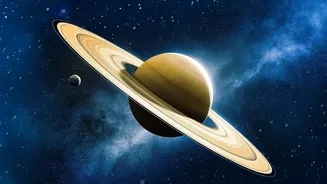
One of the most compelling recent theories proposes that the rings are the remains of a long-lost moon. Dubbed "Chrysalis," this hypothetical moon may have orbited Saturn for billions of years before its orbit became unstable around 160 million years ago. Pulled too close to the planet, it would have crossed the "Roche limit," the point where Saturn's immense gravitational pull was strong enough to tear the moon apart. According to simulations, this process would have been incredibly effective at creating the rings we see today. As Chrysalis was shredded, its icy outer layers would have dispersed to form the pristine, ice-rich rings, while its denser, rocky core was sent plunging into Saturn's atmosphere. This elegant theory not only explains the rings' youth and composition but may also account for Saturn’s unusual 27-degree axial tilt.
Or Were the Rings Always There?
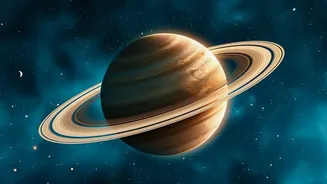
Despite the strong evidence for young rings, the debate is far from over. Some recent research challenges the youth theory, proposing that the rings could indeed be ancient, just like the planet. A 2024 study suggests that previous models may have misjudged how the rings interact with micrometeoroid dust. This new model posits that when tiny dust particles strike the icy ring material, they vaporize, and the residue is quickly cleaned away by Saturn's magnetic field, allowing the rings to remain pristine even after billions of years. This idea revitalizes the older hypothesis that the rings formed from the same primordial cloud of gas and dust that created Saturn itself. This back-and-forth highlights how complex the system is and why a definitive answer remains elusive.
The Search Continues
To finally settle the debate, scientists are looking to the future. Some theories involve collisions between two moons instead of the destruction of one. To gather more direct evidence, NASA is exploring concepts for new missions. One proposed mission, PRAXIS, would be designed to actually touch and sample the ring particles for the first time. By analyzing the composition and properties of the ring material up close, scientists could find definitive clues about its origin. Such a mission would leverage AI to navigate the hazardous ring environment. Understanding whether the rings are a recent spectacle or an ancient feature is crucial for piecing together the story of how planetary systems, including our own, form and evolve over time.