

The Age-Old Problem
For generations, Indian farmers have faced the constant threat of pests and diseases. A small patch of discoloured leaves or an unfamiliar insect can signal the start of a crisis that could wipe out an entire season's income. India loses an estimated
15-25% of its total crop production annually to these threats. Traditionally, getting a diagnosis meant finding an agricultural extension officer—a significant challenge given there are only about 100,000 officers for 140 million farm families. This delay, often lasting days, gives diseases a critical window to spread, forcing farmers into costly, and sometimes incorrect, treatments that can harm both their profits and the environment.
A Diagnosis in Your Pocket
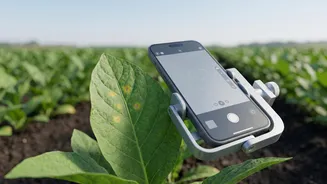
Today, a quiet digital revolution is changing this reality. Farmers are turning to “small AI”—affordable, accessible tools that run on basic smartphones. Apps like Plantix and government-backed platforms like MahaVISTAAR-AI are putting the power of an agronomist in the farmer's hand. The process is simple: a farmer takes a photo of a suspicious leaf or stem and uploads it. Within seconds, an AI model analyses the image, compares it to a vast database of crop diseases, and provides a diagnosis and recommended course of action, often in the local language.
How the 'Hack' Works
The term "smartphone sensors" primarily refers to the phone's camera. The real magic happens in the cloud. These apps use a type of AI called deep learning, where algorithms are trained on millions of labelled images of diseased and healthy plants. When a farmer uploads a new photo, the AI uses computer vision to detect patterns—like leaf spots, wilting, or mould—and matches them to a known disease with remarkable accuracy. Some apps report a success rate of over 90 percent, far surpassing the typical 60-70% accuracy of human experts making a visual diagnosis. This isn't just about identifying the problem; the apps also suggest specific, targeted treatments, reducing the overuse of broad-spectrum pesticides.
Real-World Impact in Maharashtra
In Maharashtra, these tools are already making a tangible difference. Under the state's MahaAgri-AI policy, the MahaVISTAAR-AI chatbot was downloaded more than 3 million times in just a few months, proving farmers' eagerness for reliable advice. One cotton farmer in Yavatmal used an app to identify a leaf spot disease early. He applied the recommended fungicide within 48 hours and saved his crop, while his neighbour who waited lost 30% of his yield. The small investment in the right treatment saved an estimated ₹24,000 in yield loss on a two-acre plot. Beyond individual farms, the Maharashtra government is using aggregated, anonymised data from these apps to create real-time disease maps, allowing officials to issue early warnings and manage pesticide supplies before an outbreak peaks.
The Future of Farming is Smart
The success of these AI tools highlights a major shift in Indian agriculture. It's about democratising technology, making expert knowledge accessible and affordable for the smallholder farmers who form the backbone of the nation's food security. While still evolving, the technology is rapidly expanding. The next step for platforms like MahaVISTAAR-AI is to act as an assistant that helps farmers fill out forms for government benefit schemes. As these AI initiatives scale, they promise not only to protect harvests but also to reduce costs, improve sustainability, and make farming a more resilient and profitable livelihood across India.