




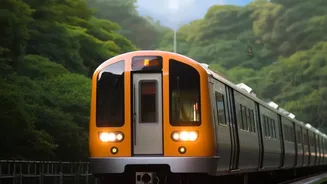
The Strategy: Maximise Time, Minimise Stress
On a short break, your time is the most valuable currency. The core of this strategy is to trade a little pre-trip planning for massive in-trip gains. Choosing a hotel within a short walk of a major, well-connected metro line transforms your experience.
Suddenly, you aren’t spending precious minutes (and money) on multiple transfers or expensive taxis just to get to the main attractions. Instead, you have a direct artery into the heart of the city. This approach dramatically cuts down on 'travel friction'—the mental energy spent navigating, the physical exhaustion of long walks to the nearest station, and the time lost in transit. You can pop back to the hotel for a quick rest or to drop off shopping bags without it derailing your day. It simplifies your itinerary, reduces travel stress, and ultimately lets you see and do more with the limited time you have.
London's Piccadilly Line: From Landing to Landmark
For visitors to London, the Piccadilly Line is a perfect example of this strategy in action. It's the dark blue line on the Tube map and a tourist's best friend. Crucially, it connects directly to all terminals at Heathrow Airport, meaning you can step off your flight and be in central London without a single change. A hotel near a Piccadilly Line station like South Kensington, Covent Garden, or Leicester Square puts you on a direct route from the airport and at the doorstep of London's finest offerings. From South Kensington, you can walk to the Natural History Museum and the Science Museum. Alight at Piccadilly Circus for the iconic lights, theatreland, and Regent Street shopping. A stop at Covent Garden places you amidst street performers, bustling markets, and the Royal Opera House. One train line effectively unlocks a huge portion of the city's most famous sights.
Dubai's Red Line: The Spine of the City
Dubai is a city of grand attractions, and many of them are conveniently strung along the state-of-the-art Dubai Metro's Red Line. This line serves as the city's primary artery, running parallel to the main highway, Sheikh Zayed Road. For tourists, it's a game-changer. It connects directly to Dubai International Airport (DXB) at Terminals 1 and 3. Staying near a Red Line station like Burj Khalifa/Dubai Mall, Emirates Towers, or DMCC means you have direct access to the city's biggest hits. You can travel seamlessly from the airport to the footsteps of the world's tallest building, the Burj Khalifa, and the sprawling Dubai Mall. Further down the line, you can get off for the Mall of the Emirates to experience Ski Dubai or connect to the tram at DMCC station to explore the Dubai Marina and Jumeirah Beach Residence.
Singapore's MRT: A Network of Possibilities
Singapore’s Mass Rapid Transit (MRT) system is a masterclass in public transport. While several lines are useful, a hotel near a station on the Downtown Line (Blue) or Circle Line (Yellow) offers incredible connectivity. For example, staying near the Promenade or Bayfront stations on the Circle Line puts you right at Marina Bay, within walking distance of Gardens by the Bay, the Marina Bay Sands resort, and the Singapore Flyer. The East-West Line (Green) conveniently connects the city centre with Changi Airport, making arrival and departure a breeze. The beauty of Singapore's network is its interchanges; a hotel near a station where two lines cross, like Chinatown or Little India, acts as a force multiplier, giving you two direct routes to explore the city's diverse cultural enclaves, food centres, and attractions.
Your Blueprint for Any City Break
You can apply this logic to almost any major city with a good metro system. Before you book your accommodation, pull up the city's official metro map online. First, identify the line that serves your arrival airport or main train station. Second, pinpoint the 3-5 attractions you absolutely must see. Now, look for where these two things overlap. Are many of your must-see spots on or near that airport line? If so, you've found your golden route. Look for hotels within a 5-10 minute walk of a station on that line. Modern tools like Google Maps allow you to see public transport lines overlaid on the map and even search for hotels nearby. A small amount of research here pays huge dividends in convenience and enjoyment once you're on the ground.