



A Star's Violent Goodbye
For most of its life, a star like our Sun provides a stable source of energy. But as it exhausts its primary fuel, it enters a dramatic and destructive final phase. The star swells into a red giant, expanding to hundreds of times its original size. This
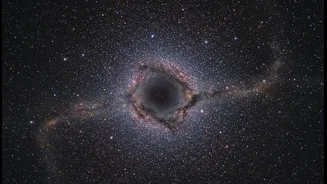
expansion is catastrophic for any planets in close orbit. In our own solar system, for instance, scientists predict the Sun will one day engulf Mercury, Venus, and possibly even Earth when it becomes a red giant in about five billion years. After this phase, the star sheds its outer layers and its core collapses into a small, incredibly dense remnant called a white dwarf. While the star is now much smaller, its powerful gravity can still wreak havoc on any surviving planets, altering their orbits and setting the stage for cosmic collisions or a slow, grinding destruction.
The Resilience of Giants
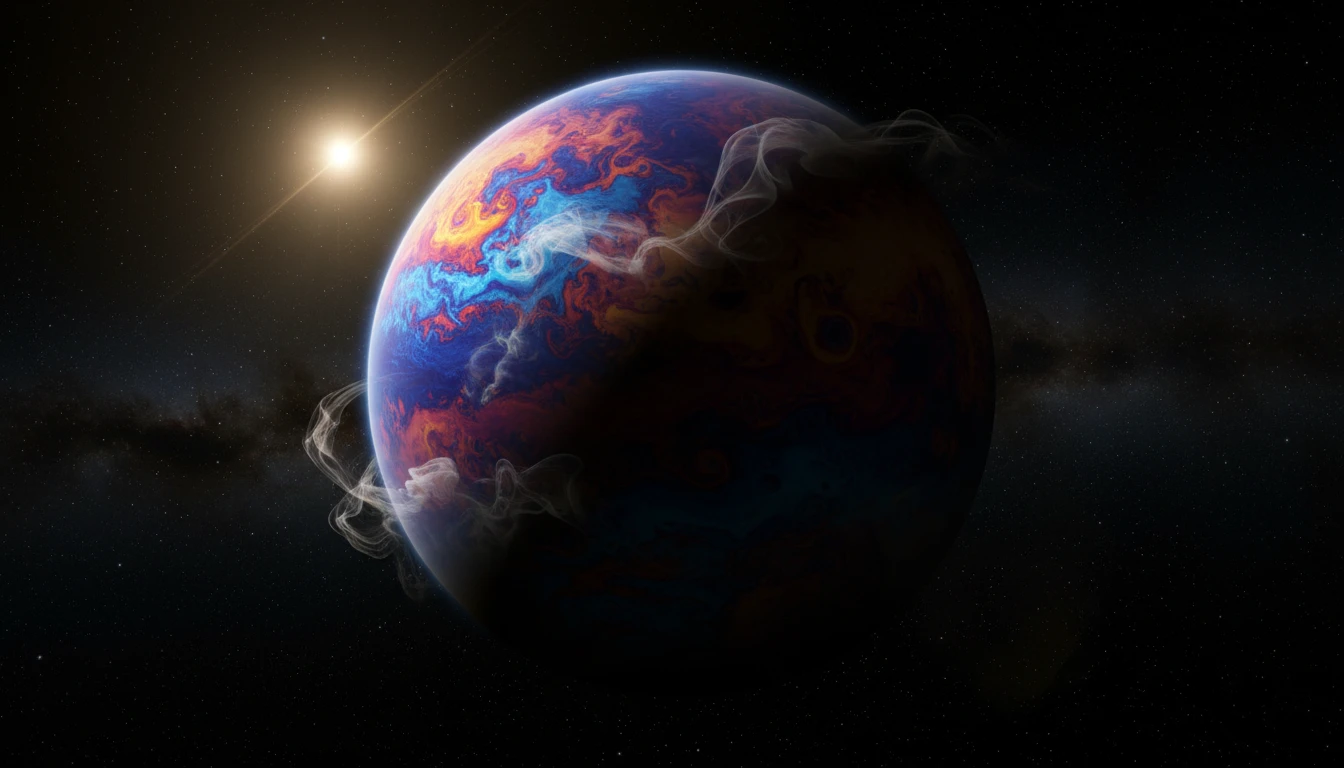
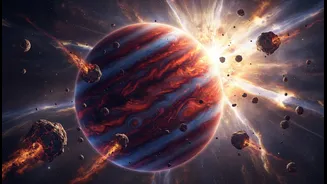
This is where size becomes a crucial advantage. Massive gas giants, like Jupiter and Saturn in our system, are far more likely to survive these stellar upheavals. Their sheer mass and distance from the host star often place them out of reach of the red giant's expanding shell. Recent discoveries, including a Jupiter-sized planet named WD 1856 b, have confirmed that giant worlds can indeed endure their star's death. Observations from the James Webb Space Telescope suggest this particular planet survived because it was originally in a wide, safe orbit during its star's red giant phase. Billions of years later, gravitational interactions within its system likely caused it to migrate closer to the now-dead star. The existence of such planets provides compelling evidence that stellar death is not necessarily the end for an entire planetary system.
A Perilous Fate for Small Worlds
Smaller, rocky planets face a much grimmer future. If they are not immediately swallowed by the red giant, they are still in danger. The intense gravity of the resulting white dwarf can pull them into a “destruction radius,” where tidal forces stretch and shred them into dust and debris. Astronomers have observed this process in action, finding white dwarfs that are “polluted” with elements like silicon, iron, and magnesium—the tell-tale chemical signatures of disintegrated rocky worlds. These observations serve as a preview of Earth's potential fate. Even if our planet were to survive the Sun's expansion, the subsequent gravitational chaos could send it, or its shattered remains, spiraling into the stellar corpse. The evidence suggests that while giant planets may live on, their smaller neighbours are often consumed.
Cosmic Bullies and Shifting Orbits
The influence of giant planets extends beyond just their own survival. In many systems, these massive worlds act as gravitational bullies, capable of dramatically altering the orbits of smaller planets. The same gravitational pulls that can protect a system by flinging dangerous asteroids away can also destabilize the orbits of Earth-sized worlds. Following a star's death, the surviving gas giants are the new rulers of the system. Their immense gravity can scatter remaining asteroids and planetary fragments, sometimes sending this debris crashing into the white dwarf. This gravitational reshuffling ensures that even long after the star has died, the planetary system continues to evolve, with the giant planets dictating the final architecture and the ultimate fate of any smaller survivors.