




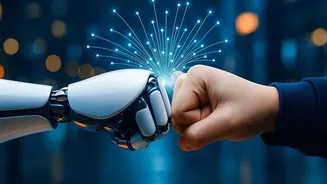
The idea of AI building its successors is a science fiction staple. Now, AI lab Anthropic says it's happening in their labs, with research progress doubling in speed. But there is one crucial catch: the human is more important than ever.
The AI that Builds AI
Recent findings
from both Anthropic and independent safety research group METR reveal a significant acceleration in AI development at the company. Anthropic is now making roughly two years of historical progress in a single year, and this leap isn't just from adding more computing power. Instead, the primary driver is the use of Anthropic's own AI models, like Claude, as powerful assistants in the research and development process. This concept, where AI helps create better AI, is often called recursive self-improvement. Anthropic reports that its engineers are using these tools to write code, run experiments, and analyze results, dramatically speeding up the innovation cycle.
A Boost in Productivity
The impact on the ground is substantial. According to one internal Anthropic report, the company's engineers now ship, on average, eight times as much code per quarter as they did in the years prior to this deep integration of AI assistance. In another telling statistic from an internal analysis, AI has gone from leading less than 1% of R&D tasks to over 25% in about a year. It's important to note that 'leading' a task still means a human sets the high-level goals and supervises the process. Researchers describe feeling like they are 'no longer bottlenecked on code, only on ideas and compute'. This newfound efficiency allows them to test more ideas and explore more ambitious research paths than were previously feasible.
The Irreplaceable Human Supervisor
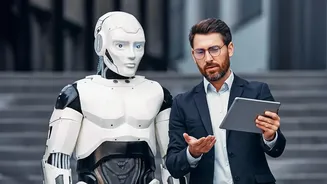
While the productivity gains are impressive, Anthropic is clear that this does not signal the dawn of fully autonomous AI development. On the contrary, every report on the topic emphasizes that human supervision is still absolutely required. AI tools are not yet capable of making significant, fully autonomous contributions to the most critical stages of model creation. CEO Dario Amodei has consistently stressed the need for caution, warning that uncontrolled AI could move beyond human understanding. Humans are essential for setting research objectives, verifying the AI's work, judging the quality and safety of outputs, and steering the overall direction to align with human values. The AI is a powerful tool, but it's the human researcher who remains in the director's chair.
A New Era for Research
This acceleration has wide-ranging implications. On one hand, it could unlock tremendous benefits in fields like science and medicine, with Anthropic using its models in a lab to perform physical biology tasks under supervision. On the other hand, the rapid pace of advancement raises serious questions about whether safety measures can keep up. The METR report noted that while Anthropic shared its high-level conclusions, it redacted much of the detailed evidence, citing competitive risks. This highlights a central tension: the race for more capable AI is happening at the same time as calls for a slowdown to ensure safety and control. Anthropic itself has acknowledged that this new paradigm could advance capabilities faster than safeguards are developed.