








The Fiery Return and a Surprise Finding
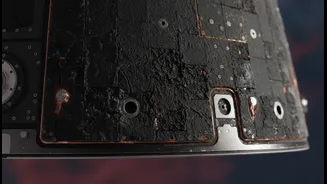
Any crewed mission's most dangerous phase is re-entry. The spacecraft, travelling at nearly 25,000 miles per hour, endures temperatures of almost 5,000 degrees Fahrenheit. The only thing protecting the astronauts is the heat shield. After the uncrewed
Artemis I mission in 2022, engineers were alarmed to find that the heat shield's material had charred and chipped away in unexpected ways. Over 100 locations showed material loss. An extensive investigation revealed that the design didn't allow gases generated within the shield material to escape properly, causing it to crack. This discovery triggered a massive engineering review and a change in the re-entry trajectory for the crewed Artemis II to reduce strain on the shield.
Post-Flight Checks on Artemis II
Following the successful splashdown of Artemis II on April 10, 2026, the Orion capsule was recovered for thorough inspection. Initial underwater imagery and subsequent analysis showed that the unexpected charring seen on Artemis I was significantly reduced, a positive sign that the engineering adjustments worked. However, every component, from the life support systems to the heat shield, is being meticulously analyzed to gather data. There is no backup for a heat shield; it simply has to work perfectly. These detailed assessments are standard procedure but are particularly crucial given the issues found after Artemis I, ensuring the safety of future missions that will land astronauts on the Moon.
India’s Own Giant Leap: The Gaganyaan Mission
Thousands of kilometres away, the Indian Space Research Organisation (ISRO) is deep in preparation for its own monumental undertaking: the Gaganyaan mission. This program aims to send Indian astronauts, or 'Gaganyatris', into a 400 km orbit and return them safely to Earth, making India only the fourth nation to achieve independent human spaceflight. The mission involves developing a suite of critical technologies, including a human-rated launch vehicle, advanced life support systems, and a robust crew escape system. Like Artemis, Gaganyaan has faced delays as ISRO prioritizes safety, with the first uncrewed flight, G1, now potentially slipping to 2027, pushing the first human flight to 2028 or later.
Why NASA's Lessons Are ISRO's Lessons
The challenges NASA faces with Orion's re-entry are directly relevant to ISRO. The Gaganyaan crew module will face the same fundamental physics when it returns to Earth. Re-entry, descent, and landing remain the most dangerous part of any spaceflight, and perfecting the thermal protection system is a non-negotiable priority. Every piece of data NASA publishes on the performance of the Orion heat shield provides invaluable, real-world insights for ISRO's engineers as they validate their own designs. Learning from NASA's experience—both its successes and its near-misses—can help ISRO refine its systems without having to learn every lesson the hard way. It's a form of international collaboration written in data and engineering papers, and it makes space safer for everyone.
A Future of Shared Ambition
The connection goes beyond just technical data. ISRO and NASA have been collaborating on the Artemis program, and Indian astronauts undergo similar training regimens. This spirit of shared knowledge underscores a modern reality of space exploration: it is an intensely collaborative field. While Gaganyaan's immediate goal of low-Earth orbit is less ambitious than Artemis's lunar objective, the engineering complexity is immense. The success of Artemis II gives confidence to the entire global space community, including India. As ISRO continues its meticulous testing, including successful ground tests of launch vehicles and parachute systems, the lessons from its American counterpart provide a crucial reference point on the long and careful road to sending Indians into space.