



A Permanent Lab in the Sky
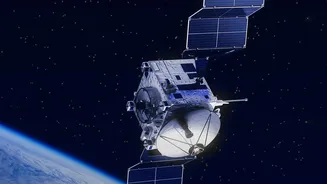
The primary benefit of the Bharatiya Antariksha Station (BAS) is establishing a permanent laboratory in microgravity. Unlike short-duration missions, a space station allows for long-term experiments that are impossible to replicate on Earth. Scientists
will be able to conduct advanced research in fields like materials science, fluid dynamics, biotechnology, and pharmaceuticals. This could lead to breakthroughs in medicine, the development of new alloys, and a deeper understanding of fundamental physics. For India, this means owning a world-class research hub to accelerate domestic innovation and attract global scientific collaboration.
Mastering Long-Duration Human Spaceflight
While the Gaganyaan mission is India's first step in sending astronauts to space, the BAS is the crucial next phase: learning to live there. The station will allow Indian astronauts, or 'Vyomnauts', to stay in orbit for months at a time. This provides an invaluable opportunity to study the long-term effects of microgravity and space radiation on the human body. ISRO will develop and perfect advanced life-support systems, including air and water recycling, which are essential for future deep-space missions. This expertise is a prerequisite for India’s goal of a crewed lunar landing by 2040.
Boosting Strategic and Diplomatic Standing
Operating a space station is a capability only a handful of nations possess. By building the BAS, India will join an elite club, cementing its status as a major spacefaring power. This enhances the nation's strategic autonomy, ensuring it is not dependent on other countries' platforms for its research or orbital activities. It also provides a powerful diplomatic tool. The BAS can serve as a platform for international collaboration, inviting scientists from other nations to conduct experiments and fostering partnerships on India's own terms, particularly with nations in the Global South.
Catalyst for Economic Growth and Tech Development
A project of this magnitude will have significant ripple effects across the Indian economy. The immense engineering challenges—from developing reliable life-support systems to robotics and docking mechanisms—will spur indigenous high-tech manufacturing. It will create opportunities for a wide range of private industries, from large corporations to startups, to contribute hardware and services, boosting India's growing space economy. Furthermore, such a high-profile national endeavor is expected to inspire a new generation to pursue careers in science, technology, engineering, and mathematics (STEM), creating a skilled workforce for the future.
A Gateway to the Moon and Beyond
The Bharatiya Antariksha Station is not just an end in itself but a crucial stepping stone for more ambitious deep-space exploration. It will serve as an ideal testbed for technologies and procedures needed for future interplanetary missions. ISRO can test new propulsion systems, practice complex in-orbit docking and refueling techniques, and validate systems for missions to the Moon and Mars. The station will allow astronauts to gain the operational experience needed for long journeys away from Earth, making the BAS an essential training ground and logistical hub for India's long-term vision in space.