



A Dazzling Galactic Embrace
The latest subject to capture the attention of astronomers is a pair of galaxies known as Arp-Madore 417-391. Located approximately 670 million light-years away in the southern constellation of Eridanus, these two galaxies are in the midst of a colossal
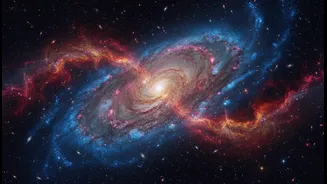
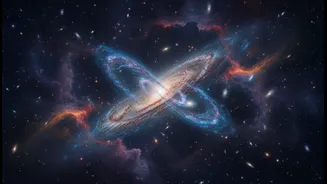
collision. In a process that takes hundreds of millions of years, their mutual gravitational pull has distorted their original shapes, pulling streams of stars, gas, and dust into a vast, glowing ring. The image, captured by the Hubble Space Telescope's Advanced Camera for Surveys, shows the two galactic cores nestled side-by-side, appearing like a bright, off-centre knot in the magnificent circular structure they created. This is a snapshot of one of the most violent and creative processes in the universe: a galaxy merger.
The Science of a Cosmic Collision
When we think of a 'collision' on this scale, it's not like a car crash. Because galaxies are mostly empty space, the individual stars within them rarely, if ever, actually hit each other. Instead, the dominant force is gravity. As the two galaxies pass through one another, their gravitational fields wreak havoc. This interaction is a process astronomers call 'violent relaxation', where the orderly orbits of stars are thrown into chaos. The powerful tidal forces strip material from the galaxies, forming the long tails and rings seen in objects like Arp-Madore 417-391. This process is a fundamental driver of galaxy evolution, providing a key mechanism through which smaller galaxies grow into the larger structures we see across the universe today.
A Starburst of Creation
One of the most significant consequences of a galactic merger is the triggering of intense star formation. As the vast clouds of interstellar gas and dust from each galaxy collide and compress, they collapse under their own gravity, creating millions or even billions of new stars in a relatively short period. This phenomenon is known as a 'starburst'. In Hubble's image of Arp-Madore 417-391, this burst of creation is visible in the brilliant blue light that dots the cosmic ring, a signature of hot, young, massive stars. Over time, as the gas is used up, star formation will slow, and the merged entity will eventually settle into a single, larger, and much older-looking elliptical galaxy.
Hubble's Enduring Role as a Cosmic Scout
Even with the advanced capabilities of the newer James Webb Space Telescope (JWST), the Hubble Space Telescope remains a vital tool for astronomers. This observation of Arp-Madore 417-391 is part of a specific program designed to build a list of intriguing targets for future, more detailed study by JWST and other ground-based observatories. Hubble is being used to survey peculiar and previously unobserved galaxies, essentially acting as a scout to identify the most compelling cosmic phenomena worthy of a closer look. After more than three decades in orbit, Hubble continues to not only make profound discoveries but also to set the stage for the next generation of scientific inquiry, maximizing the efficiency and impact of its powerful successor.
A Glimpse of Our Own Distant Future?
Observing a galactic merger like this isn't just an academic exercise; it could be a preview of our own home galaxy's destiny. The Milky Way is on a long-term collision course with our nearest large neighbour, the Andromeda galaxy. While the exact collision was once thought to be certain in about 4.5 billion years, recent studies suggest the interaction is more complex and less predictable. Still, the eventual gravitational dance between the two is a likely outcome. Witnessing the spectacular and transformative power of the Arp-Madore 417-391 merger provides a stunning, real-world example of the forces that will one day reshape our corner of the universe, eventually forming a new, giant galaxy often nicknamed 'Milkomeda'.