


1. It's A Brand-New Discovery
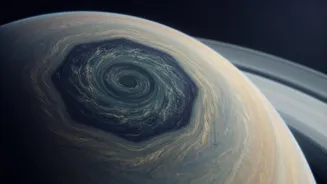
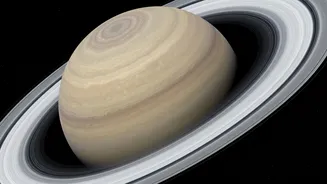
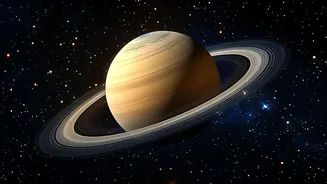
For decades, scientists have known about a massive, stable, six-sided jet stream—the hexagon—swirling over Saturn's north pole. They long searched for a similar feature in the south, but missions like NASA's Cassini spacecraft, which orbited the planet
from 2004 to 2017, found no lasting polygonal shape. This new decagon is a recent development. The first faint hints were captured by the Hubble Space Telescope in October 2023, with the shape becoming clearer through 2024 and fully defined in observations from 2025. Its recent appearance makes it a rare opportunity for scientists to watch a massive planetary weather pattern develop in real-time.
2. It's The Hexagon's Southern Cousin, But Different
This 10-sided wave is the first large, regular-sided pattern ever seen in Saturn's southern hemisphere, making it a counterpart to the northern hexagon. However, there are key differences. The hexagon at the north pole has been a remarkably stable fixture for over 40 years. In contrast, the southern decagon appears to be actively evolving and strengthening. While the hexagon is fixed at around 78°N latitude, the new decagon has emerged near 63°S. This discovery shows that the conditions in Saturn's atmosphere can create different polygonal waves in both hemispheres.
3. It's a Wave, Not a Solid Object
Like the hexagon, the decagon is not a physical 10-sided object. It is a massive atmospheric wave traveling along one of Saturn's powerful jet streams. These jets, with winds racing at speeds up to 420 kilometers per hour, can develop meandering patterns that become trapped and form stable geometric shapes. The decagon appears to be a vertically extended structure, meaning it stretches through multiple layers of the atmosphere, from the icy ammonia clouds at the top down into the planet's troposphere. This 3D structure indicates it's a deep and significant atmospheric phenomenon, not just a surface-level cloud pattern.
4. A Nearby 'Red Spot' May Have Triggered It
While the exact cause is still a mystery, scientists have a leading hypothesis. They believe the wave may have been created by a disturbance in the jet stream, possibly driven by a nearby swirling vortex. Just north of the decagon, there is a large anticyclone—a high-pressure storm system analogous to Jupiter's famous Great Red Spot. This vortex darkened significantly in 2025, just before the decagon became clearly defined. Researchers theorize this storm could be forcing the jet stream to oscillate, creating the 10-sided wave. However, they remain cautious, as a similar vortex near the northern hexagon disappeared years ago while the hexagon itself remained stable.
5. It Offers a Window Into Saturn's Deep Atmosphere
Studying these giant waves provides a natural laboratory for understanding the dynamics of gas giants. Since we cannot send probes deep into Saturn's crushing atmosphere, these patterns act as a window, revealing clues about the winds and forces at play far below the cloud tops. By tracking how the decagon evolves—whether it stabilizes like the hexagon or breaks apart—scientists can test and refine their models of planetary atmospheres. The ongoing observation of this new feature will help answer fundamental questions about why these geometric shapes form and what they tell us about the hidden workings of planets in our solar system and beyond.