



Meet K2-18b, a 'Hycean' World
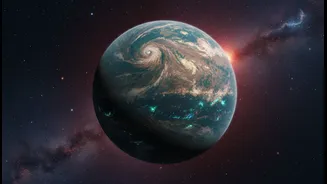
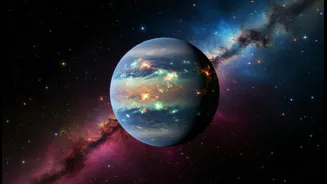
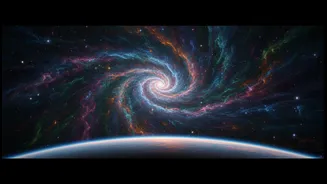
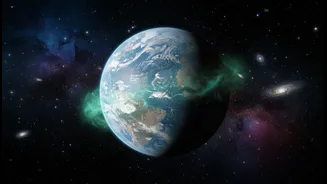
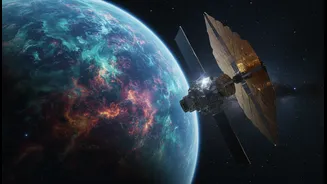
K2-18b is not an Earth-twin. It's a 'sub-Neptune' exoplanet, roughly 8.6 times the mass and 2.6 times the size of our own planet. It orbits a cool red dwarf star within the habitable zone, the region where temperatures could allow for liquid water to
exist. Scientists, including a team led by Professor Nikku Madhusudhan of Cambridge University, have categorised it as a potential 'Hycean' world—a theoretical type of planet covered by a deep ocean with a hydrogen-rich atmosphere. The James Webb Space Telescope (JWST) previously detected carbon-bearing molecules like methane and carbon dioxide, which supports the idea of it having a water ocean, making it a prime target in the search for life.
The 99.7% Signal Explained
The excitement revolves around the detection of dimethyl sulfide (DMS) in the planet's atmosphere. The '99.7%' figure refers to the statistical confidence of the detection, also known as a 'three-sigma' result. This means there's only a 0.3% chance that the signal is a random fluke or statistical noise. While this is a high level of confidence, it falls short of the 'five-sigma' gold standard (a 99.9999% certainty) that physicists and astronomers require before officially claiming a discovery. So, while the signal is compelling, it's still considered tentative and requires further verification.
Why Dimethyl Sulfide Is So Exciting
The reason astronomers are so interested in dimethyl sulfide is simple: on Earth, it is only produced by life. Specifically, it is primarily made by microscopic marine life like phytoplankton. For decades, astrobiologists have considered DMS a top-tier 'biosignature'—a substance that provides strong evidence of past or present life. Finding it on a world like K2-18b, which is believed to have a massive ocean, is the most promising lead so far in the search for biology beyond our solar system. The concentration of DMS detected is also thousands of times higher than what is found on Earth, which, if confirmed, could suggest a planet 'teeming with life'.
The Case for Scientific Caution
Despite the strong signal, the scientific community remains cautious. The headline 'Not Confirmed Life' is crucial. Firstly, a three-sigma detection needs to be strengthened with more data. Secondly, while DMS on Earth is linked only to life, K2-18b is a very different world. Scientists cannot yet rule out an unknown abiotic (non-biological) chemical or geological process that could produce DMS under the unique conditions of a Hycean planet. In recent years, DMS has also been found in cometary material and interstellar space, proving it can exist without life, though in much lower concentrations. Other researchers have also pointed out that different interpretations of the data are possible, with some suggesting the planet could have a magma ocean instead of a water one.
What Happens Next in the Search?
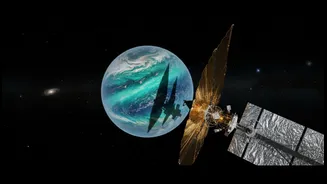
The next step is to get more data. The research team has proposed further observations with the James Webb Space Telescope to hopefully confirm the DMS signal and push the detection past the crucial five-sigma threshold. This would involve pointing the telescope at K2-18b for many more hours to gather higher-quality light spectra from its atmosphere. Independent teams will also re-analyse the existing data to see if they reach the same conclusions. Ultimately, even if DMS is definitively confirmed, the scientific community will then need to rigorously exclude every possible non-biological explanation for its presence before the word 'life' can be used with certainty. This process of verification is slow and methodical, but it is the foundation of scientific discovery.