




Nature’s Own Sea Wall
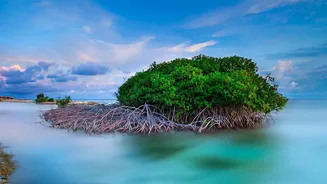
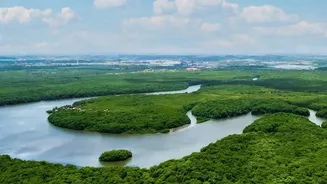
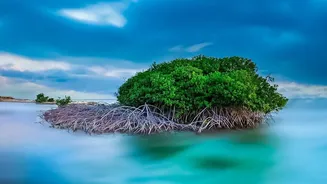
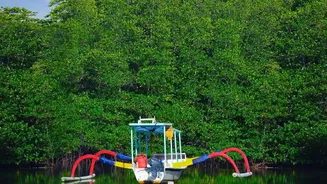
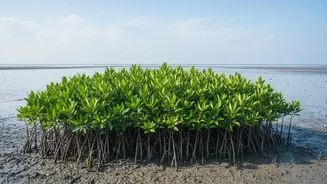
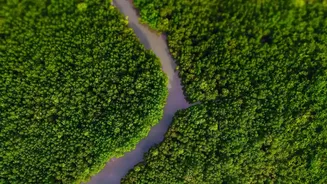
Mangrove forests are more than just trees; they are complex ecosystems that serve as a natural barrier between land and sea. Their dense, interlocking root systems are uniquely adapted to act as a 'bio-shield'. These roots anchor the shoreline, trapping
sediment and building up the land over time. When storm surges or high tides roll in, this tangled network of roots and trunks absorbs and dissipates the wave's energy, dramatically reducing its force before it can reach coastal communities. Studies have shown that a healthy mangrove forest can reduce wave height by significant margins, offering a level of protection that often surpasses artificial embankments. This natural defence mechanism is crucial for safeguarding lives, homes, and agricultural land from the destructive power of the sea.
From Policy to Plantation
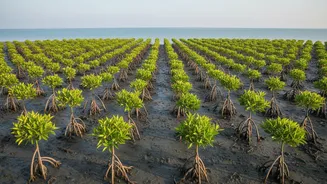
The renewed focus on mangroves is being driven by coordinated national efforts. A key example is the Mangrove Initiative for Shoreline Habitats & Tangible Incomes (MISHTI), launched in 2023. This central government scheme aims to restore and expand mangrove forests across India's vast coastline, with a specific focus on degraded areas. By converging with other programs like the rural employment guarantee scheme (MGNREGS), MISHTI not only plants trees but also creates employment for local communities, making them direct stakeholders in the conservation effort. Recent reports from March 2026 indicate the program is being implemented across nine coastal states, aiming to restore 540 square kilometers of mangroves and strengthen the country's ecological security.
Success Stories from the Shorelines
The benefits of these bio-shields are most evident in states frequently in the path of cyclones, like Odisha and West Bengal. In Odisha, community-led restoration projects are transforming vulnerable coastlines. Following devastating cyclones, villages protected by healthy mangrove belts, such as those in the Bhitarkanika and Kendrapara regions, have consistently reported significantly less damage compared to exposed areas. For instance, after the 1999 super cyclone, a clear difference was observed between protected and unprotected villages. More recent community projects, often led by women, have successfully planted tens of thousands of saplings, rebuilding natural barriers that not only protect from storms but also revive local fisheries. These local initiatives show tangible results, with villagers reporting reduced erosion and a visible return of biodiversity.
More Than Just a Shield
The value of mangroves extends far beyond coastal protection. These unique forests are biodiversity hotspots, acting as critical nursery grounds for countless species of fish, crabs, and shrimp. This directly supports the livelihoods of coastal communities who depend on fishing. Furthermore, mangroves are champions of climate change mitigation. They are highly efficient 'blue carbon' sinks, capable of sequestering and storing significantly more carbon per hectare than many terrestrial forests. They also provide non-timber resources like honey and fodder, contributing to a diverse local economy. By investing in mangroves, India is not just building a shield against storms but also bolstering food security, supporting local economies, and fighting climate change.
The Challenges Ahead
Despite the clear successes, the path to fully restoring India's mangrove cover is not without obstacles. These vital ecosystems remain under threat from urbanization, pollution from industries, and the expansion of aquaculture. Climate change itself poses a risk through sea-level rise, which could submerge existing mangrove forests if they cannot adapt or migrate inland. Ensuring the long-term success of plantation projects requires continuous effort. It depends on strong community involvement, effective policy enforcement to prevent illegal felling, and scientific monitoring to ensure the right species are planted in suitable locations. Sustained investment and empowering local communities, particularly women's groups who have proven to be dedicated custodians of these forests, will be key to overcoming these challenges.