



A New Era of Planetary Science
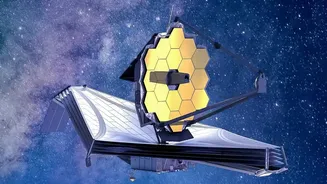
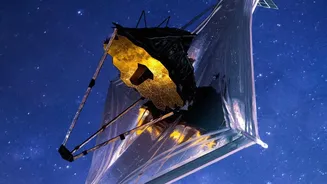
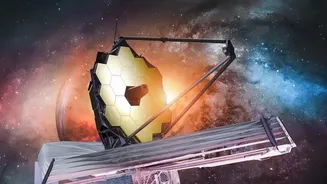
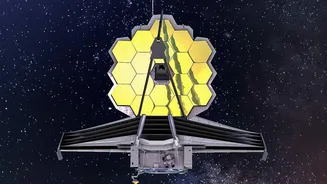
In a remarkable display of technological prowess, the James Webb Space Telescope (JWST) is fundamentally changing our understanding of planets beyond our solar system. Astronomers are now moving past simply detecting these distant worlds, known as exoplanets,
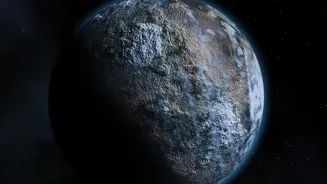
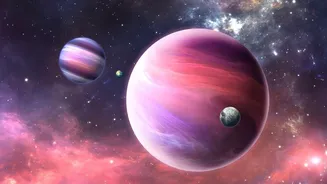
to actively analysing their atmospheric composition. Using a technique called transmission spectroscopy, the JWST has successfully identified the chemical fingerprints of water vapour in the atmospheres of several exoplanets. While signatures have been detected on gas giants like WASP-96 b, the recent hints of water around rocky super-Earths like GJ 486 b mark a pivotal moment. Though scientists are still carefully working to confirm if the signal for GJ 486 b comes from the planet or its host star, the capability itself represents a monumental leap forward in our quest to find habitable worlds.
Webb’s Infrared Superpower
The secret to this new capability lies in the JWST’s specialisation in infrared light. Unlike its predecessor, the Hubble Space Telescope, which primarily observes in visible and ultraviolet light, Webb is designed to capture the universe in infrared. This is crucial for studying exoplanet atmospheres. When an exoplanet passes in front of its host star from our perspective—an event called a 'transit'—the starlight filters through the planet’s atmosphere. Different gases in the atmosphere absorb specific wavelengths, or 'colours,' of this light. Since molecules like water, methane, and carbon dioxide absorb light most strongly in the infrared part of the spectrum, Webb is perfectly tuned to spot these missing bands of light. This allows scientists to deconstruct the starlight and identify precisely which chemicals are present in that alien air.
The Science of Spectroscopy
At the heart of this discovery is spectroscopy. Think of it as using a cosmic prism. An instrument aboard the JWST, such as the Near-Infrared Spectrograph (NIRSpec), takes the collected starlight and splits it into its full spectrum, like a rainbow. If a planet has no atmosphere, this spectrum will be smooth and complete. But if it has an atmosphere, the gases within it will absorb light at very specific frequencies, creating dark lines or gaps in the spectrum. Each molecule has a unique absorption pattern, a 'barcode' that allows astronomers to identify it with certainty. The detection of water vapour on gas giant WASP-96 b was one of the first and most detailed demonstrations of this, showing a clear barcode for H2O. This method is so precise that scientists believe it can reveal not just the presence of certain molecules, but also their relative abundance, offering clues about the planet's climate and chemistry.
A Crucial Ingredient for Life
Finding water vapour is a profound first step in the search for extraterrestrial life. While its presence, especially on a scorching hot gas giant, does not imply life exists there, it proves that the building blocks for life as we know it are present throughout the galaxy. The ultimate goal for many astronomers is to use this same technology to study smaller, rocky planets within the 'habitable zone' of their stars—the orbital region where temperatures are just right for liquid water to exist on a planet's surface. Detecting water vapour in the atmosphere of such a world would be a top-priority indicator for habitability. The JWST is also searching for other potential 'biosignatures,' such as methane and carbon dioxide, which can be produced by living organisms. The telescope has already successfully detected carbon dioxide and sulfur dioxide on other worlds.
What Comes Next in the Search?
This is just the beginning of a new chapter in exoplanet exploration. The initial findings are a powerful proof of concept, demonstrating that the JWST can perform this delicate analysis with unprecedented precision. Scientists are now compiling lists of promising rocky exoplanets for further study. Even when results are ambiguous, such as with GJ 486 b where the water signal could be from cool spots on the star itself, the process refines our methods. Future observations with other Webb instruments, like the Mid-Infrared Instrument (MIRI), will help distinguish between stellar and planetary signals by creating temperature maps of these planets. By systematically surveying dozens of worlds, astronomers hope to build a census of planetary atmospheres, understand their diversity, and ultimately zero in on the one that might look a lot like our own.