

How to See Water From Light-Years Away
The magic behind these discoveries lies in a technique called transmission spectroscopy. Imagine an exoplanet passing in front of its host star from our point of view. As the starlight shines through the edge of the planet's atmosphere, molecules within
that atmosphere absorb specific colours, or wavelengths, of light. Each molecule, whether it's methane, carbon dioxide, or water, has a unique 'fingerprint' it leaves on the light. The James Webb Space Telescope, with its incredible infrared sensitivity, acts like a cosmic detective, catching this filtered starlight and splitting it into a rainbow called a spectrum. By analysing which colours are missing, scientists can determine precisely what gases are present in that alien air, even from hundreds of light-years away.
Water Found in Unexpected Places
Webb has already proven its extraordinary capability, finding signs of water in a variety of exoplanet systems. One of the most exciting early discoveries was the detection of water vapour in the inner disk of the PDS 70 system, a region where rocky, Earth-like planets are thought to be forming. This was the first time water had been spotted so close to a star in a system already known to be building planets, suggesting that the raw ingredients for life could be available right from the start. More recently, in mid-2026, JWST detected semi-heavy water in the atmosphere of the exoplanet WASP-39b, a different variant of H2O that can provide clues about a planet's formation history. These findings expand the range of worlds astronomers consider for further study.
Not Oceans, But a Crucial Clue
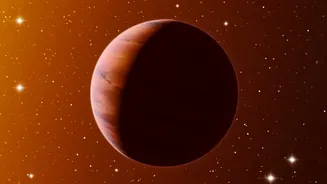
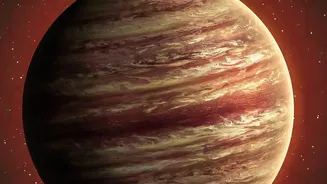
It is important to understand that detecting 'water vapour' does not mean Webb is seeing swirling oceans or rainy clouds on these distant worlds. Often, these detections are made on 'hot Jupiters' or 'sub-Neptunes'—gas giants where conditions are far too extreme for liquid water to exist on a surface. For instance, on the hot Jupiter NGTS-2 b, Webb found muted signs of water in a scorching atmosphere of about 1,470 Kelvin. What these findings do provide is powerful proof of concept. They show that our technology can successfully identify water signatures across a vast cosmic distance. It allows scientists to refine their models and understand the chemistry of planetary evolution, essential groundwork for the ultimate search.
A Stepping Stone to Habitable Worlds
The long-term goal is to turn this powerful tool towards smaller, rocky planets orbiting within their star's 'habitable zone'—the 'Goldilocks' region where temperatures are just right for liquid water to potentially exist on the surface. Detecting the atmosphere of a smaller, Earth-sized planet is vastly more challenging, as its atmosphere is much thinner. However, a reported detection of H2O signatures in the habitable zone of a rocky world orbiting a red dwarf star in April 2026 demonstrates this is now within reach. Such discoveries, if confirmed, would be monumental. Since red dwarfs are the most common type of star in our galaxy, finding that their planets can hold onto water would dramatically increase the number of potentially habitable worlds.
The Challenges and the Future
The path forward is not without its difficulties. The atmospheric signals are incredibly faint, and interpreting the data requires complex models to untangle various factors like clouds, haze, and atmospheric pressure. Sometimes, as one 2026 study suggested, a planet's water might be hidden deep beneath an atmosphere that appears dry to a telescope. But each observation brings new clarity. Webb is not just looking for water; it is building a catalogue of alien atmospheres, revealing secrets about their chemistry, formation, and evolution. This new era of exoplanet research is about moving beyond simply counting planets to truly characterising them.