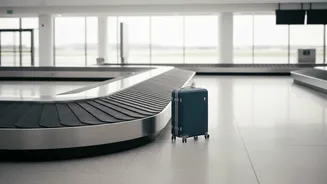







The Ruling That Reaffirms Your Rights
In a significant move for passenger rights, a recent consumer commission ruling held an airline accountable for a three-day baggage delay, ordering a substantial payout. The case, which involved a passenger travelling from Jammu to Coimbatore, highlighted
the airline's failure to compensate as per the Ministry of Civil Aviation's Passenger Charter. The court ordered the airline to not only reimburse the passenger for essential purchases made during the delay but also to pay compensation for the service deficiency and litigation costs. This ruling serves as a powerful reminder that passengers have clear, enforceable rights, and airlines have a mandated duty to compensate for mishandled baggage. It underscores the importance of not just knowing your rights but also knowing exactly how to exercise them.
Your First Move: The Property Irregularity Report (PIR)
The moment you realise your bag hasn't made it, your first and most critical action is to file a Property Irregularity Report (PIR). Do not leave the arrival hall. Head straight to the airline’s baggage service counter. Filing a PIR is non-negotiable; without this document, an airline can legally reject your claim. This report is the official start of your paper trail. It will include your flight details, baggage tag number, and a description of your luggage. You will be given a copy with a unique reference number. Guard this document and reference number carefully—it is the foundation of any future claim for delay, damage, or loss.
Building the Essential Paper Trail
Beyond the PIR, a robust paper trail is your best defence. Keep every related document in one place. This includes your original flight ticket or e-ticket, boarding pass, and, crucially, the baggage tag sticker that is usually placed on the back of your boarding pass or passport. If your bag is delayed and you need to purchase essential items like toiletries or a change of clothes, keep every single receipt. Airlines are liable to reimburse these necessary expenses. For damaged baggage, take clear photographs of the damage from multiple angles before leaving the airport, if possible. For lost luggage that may contain valuable items, any proof of purchase or ownership for those items will be vital when filing a detailed claim later.
Understanding Compensation and Timelines
The Directorate General of Civil Aviation (DGCA) has set clear rules for compensation. For domestic flights, the liability for loss, delay, or damage is up to ₹20,000 per passenger. For international flights, the compensation is governed by the Montreal Convention, which is approximately ₹1.5 lakh. A bag is considered officially 'lost' if it is not traced within 21 days of filing the PIR. At this point, you can file a formal claim for the value of the lost bag and its contents, up to the liability limit. Remember, the initial PIR is a report, not a claim. You must follow up with a formal written claim to the airline within the stipulated time—usually 7 days for damaged bags and 21 days for delayed or lost bags.
Escalating Your Claim: When the Airline Doesn't Respond
If the airline is unresponsive or rejects your valid claim, you have clear escalation paths. The first step is to contact the airline's designated Grievance Redressal Officer. If you remain unsatisfied, the Ministry of Civil Aviation's AirSewa portal is your next port of call. This free government service acts as an intermediary to push for a resolution. You can register a complaint using your PNR and track its status. For unresolved issues, you can file a complaint with a consumer commission through the E-Daakhil portal, which recent rulings have shown to be an effective measure for holding airlines accountable.