

Shifting Focus to Water Worlds
For decades, the search for life focused on finding 'Goldilocks' planets: rocky worlds at the perfect distance from their star for liquid water to exist on the surface. But recent science has dramatically expanded that view. The new frontier is 'ocean
worlds'—icy moons in our own solar system that hide vast, liquid oceans beneath their frozen shells. Two of the most compelling targets are Jupiter's moon Europa and Saturn's moon Enceladus. Though their surfaces are frozen solid, gravitational tugging from their giant host planets is thought to generate enough internal heat to maintain these subsurface seas, which could contain more water than all of Earth's oceans combined.
Sampling an Alien Ocean at Enceladus
Enceladus is particularly exciting because it's actively spraying its ocean out into space. Data from the Cassini spacecraft, which flew through these plumes, revealed not just water but also salts, silica, and complex organic molecules—the very building blocks of life. While Cassini's mission ended in 2017, recent lab experiments have added to the excitement. A study published in early October 2026 showed that Earth microbes can survive and grow in simulated Enceladus seafloor conditions, which are highly alkaline. This doesn't prove life exists there, but it demonstrates that the moon's strange chemistry, once seen as a barrier, might actually be hospitable. The presence of all these ingredients—water, energy, and organic chemicals—makes Enceladus a top-tier candidate for habitability.
The Quest of Europa Clipper
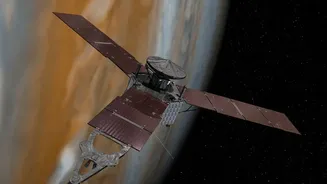
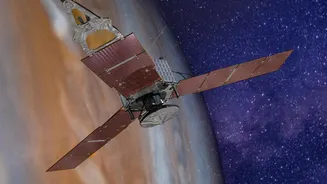
While Enceladus vents its secrets, getting to Europa's ocean is a bigger challenge. Launched in October 2024, NASA's Europa Clipper spacecraft is currently on a long journey to Jupiter, scheduled to arrive in orbit in April 2030. Europa Clipper is the largest interplanetary spacecraft NASA has ever built and is equipped with a suite of instruments, including ice-penetrating radar, to investigate if the moon's hidden ocean could support life. While it won't land or drill, its repeated close flybys will map the moon's surface, measure the ice shell's thickness, and search for active plumes like those on Enceladus, giving us our most detailed picture yet of this potential water world. On its way, the spacecraft is already proving its mettle; it used a Mars gravity assist in March 2025 and is on track for an Earth gravity assist in December 2026.
Clues from the Martian Past
Closer to home, the search continues on Mars. While the Red Planet is now cold and dry, evidence points to a warmer, wetter past. Recent discoveries by the Perseverance rover have bolstered this case. In June 2026, NASA announced that the rover had found the highest concentration of complex organic molecules ever detected on Mars within mudstones in the Jezero crater. These macromolecular carbon compounds are not definitive proof of life—they can also be created by geological processes—but they are precisely the kind of potential biosignatures scientists have been hoping to find. Found in a dried-up riverbed, these molecules show that the building blocks for life were present on Mars billions of years ago and could have been preserved.
Whispers from Distant Atmospheres
Beyond our solar system, the James Webb Space Telescope (JWST) is opening a new chapter by analyzing the atmospheres of distant exoplanets. One planet of intense interest is K2-18b, a world about 120 light-years away. Initial observations in 2023 suggested the presence of dimethyl sulfide (DMS), a gas that on Earth is overwhelmingly produced by life, particularly marine plankton. While still not fully confirmed, further study has strengthened the case, though scientists remain cautious, emphasizing the need for more data. The JWST's work highlights a critical shift: we are moving from simply cataloging exoplanets to being able to probe their chemistry, searching for the faint chemical fingerprints that life might leave behind in their skies.