




The Cosmic Middle Child
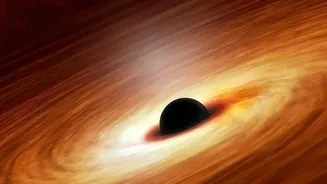
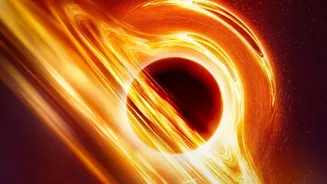
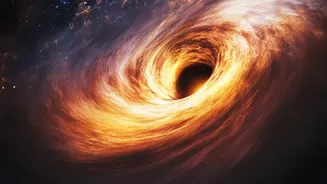
In the world of black holes, scientists have long had strong evidence for two main sizes: small and supermassive. The small ones, known as stellar-mass black holes, are typically a few to a hundred times the mass of our sun. They form when a single, giant
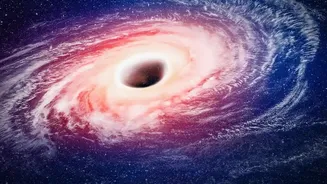
star collapses under its own gravity. At the other extreme are the supermassive black holes, behemoths that are millions or even billions of times more massive than the sun, found at the heart of most large galaxies, including our own Milky Way. But what about the in-between? Logically, there should be a class of 'middleweight' black holes, dubbed intermediate-mass black holes (IMBHs), ranging from 100 to 100,000 solar masses. These have been incredibly difficult to find, representing a frustrating gap in our understanding of cosmic evolution. Scientists believe they are the seeds from which supermassive black holes grow, but proving their existence and growth mechanisms has been a major challenge.
A Symphony of Spacetime
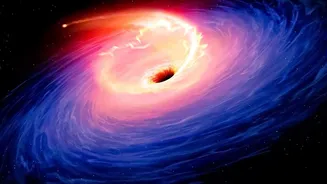
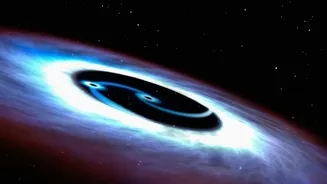
The key to this new discovery lies with gravitational waves. First predicted by Albert Einstein, these are invisible ripples in the very fabric of spacetime itself. You can think of them like the ripples that spread across a pond when you toss in a stone. In space, the most powerful ripples are created by the most violent events imaginable, like the collision of two black holes. As two massive objects, like black holes, orbit each other, they disturb the spacetime around them, sending out gravitational waves. This process isn't free; the waves carry energy away from the orbiting system. This loss of energy is crucial. It causes the two black holes to spiral closer and closer together in a deadly cosmic dance that can last millions of years but ends in a fraction of a second.
Hearing the Inevitable Collision
The headline-making news is that scientists have now definitively observed this process happening with intermediate-mass black holes. Using a global network of incredibly sensitive detectors — the LIGO, Virgo, and KAGRA observatories — researchers can “listen” for these faint gravitational tremors from space. Recent detections have captured the unique signatures of IMBH mergers. These signals confirm the long-held theory: the steady loss of energy through gravitational waves is precisely what drives these black holes together until they merge into one larger entity. When they finally collide, a portion of their combined mass is converted directly into a final, colossal burst of energy in the form of gravitational waves, a cosmic scream that travels across the universe. For example, the historic detection of GW190521 involved two black holes merging to form a 142-solar-mass IMBH, radiating away the equivalent of eight suns' worth of mass as pure gravitational energy.
Hierarchies and Second Generations
These new observations do more than just confirm a theory; they provide compelling evidence for a process called “hierarchical merging.” This is the idea that black holes can be “second-generation” objects, born from the collisions of smaller black holes. Recent studies analyzing the growing catalog of gravitational wave events have found that a significant percentage of mergers show signs of being hierarchical. One clue is when one black hole in a merging pair is spinning much faster than its partner, suggesting it was itself the product of a previous merger. Observing IMBHs forming this way confirms they are a vital stepping stone. Stellar-mass black holes merge to create IMBHs, and these IMBHs can then continue to merge and grow, eventually becoming the supermassive black holes we see today.
A New Chapter in Cosmology
Confirming that gravitational wave energy loss drives IMBH mergers is a watershed moment for astronomy. It fills in a huge blank in the story of how the largest structures in the universe are built. With each new detection, the catalog of these events grows, allowing scientists to map the populations of black holes with increasing precision. This isn't just about understanding black holes themselves. By studying these events, scientists can test the limits of Einstein's theory of general relativity, probe the expansion rate of the universe, and understand the environments where these cosmic collisions are most likely to happen, such as dense star clusters. We have moved from asking if these mergers happen to asking how they shape the cosmos on the grandest scale.