





A Star's Final, Fiery Act
Most stars in the universe, including our own Sun, will not end their lives with a spectacular supernova. Instead, they follow a more gradual, yet still dramatic, path. When a star with a mass up to about eight times that of our Sun exhausts its hydrogen
fuel, it begins to swell into a red giant. This expansion is enormous, often engulfing any planets in the inner solar system. After this phase, the star sheds its outer layers of gas, creating a beautiful, glowing structure called a planetary nebula. What’s left behind is a small, incredibly dense, Earth-sized core known as a white dwarf. This stellar remnant is essentially the hot, cooling cinder of a once-mighty star, packing a Sun's worth of mass into a tiny volume.
The Mystery of the Missing Mass
A crucial part of this story is mass loss. The star that becomes a white dwarf is significantly lighter than it was during its prime. For example, a star that began with two solar masses might end up as a white dwarf with only 70% of the Sun's mass. Accurately measuring how much mass is lost during this evolution is vital for understanding stellar life cycles, the chemical enrichment of galaxies, and even for determining the age of star clusters. This relationship between a star's initial mass and its final white dwarf mass is a cornerstone of astrophysics, known as the Initial-Final Mass Relation (IFMR). However, measuring it accurately has always been a major challenge for scientists.
A Witness from a Ruined World
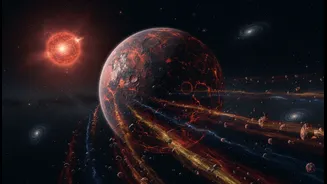
This is where a surviving planet comes in. In a landmark discovery, astronomers studied a white dwarf named SDSS J1228+1040, located about 410 light-years away. Orbiting this dead star is not a full-fledged planet, but a planetesimal—a dense, metallic fragment thought to be the core of a much larger planet that was torn apart. This resilient chunk of rock and metal is whipping around its star every two hours, an astonishingly close orbit that it could only survive due to its high density, likely being rich in iron and nickel. The intense gravity of the white dwarf stripped away the planet's lighter crust and mantle, leaving only the tough core behind.
Cosmic Forensics in Action
The existence of this planetary remnant provides a unique laboratory. By precisely measuring the orbit of the surviving body, astronomers can work backwards. The laws of gravity dictate the relationship between an orbiting object's period, its distance, and the mass of the star it circles. Observing the planetesimal's orbit allows for a precise calculation of the white dwarf's current mass. Knowing this final mass is the key. Scientists can then use stellar evolution models to determine the star's initial mass when it was on the main sequence. The difference between the initial mass and the final, measured mass of the white dwarf gives a direct, empirically-backed measurement of how much mass the star shed during its red giant phase.
A Glimpse into Our Own Future
This method offers a powerful new tool to refine our understanding of how stars evolve and die. Each discovery of a planet or fragment orbiting a white dwarf, like the Jupiter-sized planet WD 1856 b, adds another crucial data point. These systems are more than just cosmic curiosities; they are previews of our own solar system's distant future. In about five billion years, our Sun will become a red giant and then a white dwarf. While planets like Mercury and Venus will be consumed, others may survive. The study of these hardy survivors around dead stars is not just about weighing the past; it's about piecing together the ultimate fate of planets across the galaxy, including our own corner of it.