



The Universe’s Greatest Puzzle
For nearly three decades, one of the biggest questions in physics has been 'What is dark energy?'. Scientists know something is causing the expansion of the universe to speed up, a discovery that defied the expectation that gravity would be slowing things
down. They gave this mysterious force a name, but its true nature remains unknown. Theories range from it being an intrinsic energy of empty space, known as the cosmological constant, to a new, undiscovered field or even a sign that our theory of gravity is incomplete. Whatever it is, it appears to make up the majority of the cosmos, so understanding it is fundamental to understanding our universe's past and future.
Introducing the CHIME Telescope
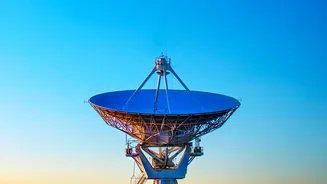
Enter the Canadian Hydrogen Intensity Mapping Experiment, or CHIME. Located in British Columbia, Canada, CHIME doesn't look like a typical telescope. It has no moving parts and consists of four large, half-pipe-shaped reflectors that scan the entire northern sky every single day as the Earth rotates. While originally designed to map the most abundant element in the universe—hydrogen—CHIME has also become a world-leading machine for detecting Fast Radio Bursts (FRBs), mysterious millisecond-long blasts of energy from deep space. Its immense sensitivity and ability to process staggering amounts of data, comparable to the world's mobile data traffic, make it a uniquely powerful instrument.
A Breakthrough in Measurement
The latest breakthrough isn't the discovery of dark energy, but a new way to hunt for its effects. One of CHIME's main goals was to measure how the universe expanded over time by charting the large-scale structure of hydrogen gas. This technique, called 'intensity mapping', measures the faint radio glow of neutral hydrogen from billions of years ago. Until now, to prove their measurements were real, researchers had to compare CHIME's radio maps with galaxy surveys from other telescopes—an expensive and time-consuming process. In a recent milestone, the CHIME team demonstrated it can detect this ancient hydrogen signal using only its own observations. This standalone method is a game-changer, proving the technique works and offering a faster, more cost-effective way to map the cosmos.
Why This Method Is a Game-Changer
This new method is powerful because it uses the universe's structure as a giant measuring stick. In the early universe, sound waves left behind a characteristic pattern in the distribution of matter, known as Baryon Acoustic Oscillations (BAO). This pattern expanded along with the universe, creating a 'standard ruler' that cosmologists can measure. By observing the distribution of hydrogen gas at different points in cosmic history, CHIME can see how this ruler has changed, which directly reveals the universe's expansion history. Unlike traditional galaxy surveys that painstakingly map individual galaxies, CHIME's intensity mapping approach surveys vast volumes of space much more quickly. This provides a powerful, independent tool to test theories about dark energy.
A Better Tool, Not a Final Answer
It is crucial to understand that this achievement does not tell us what dark energy is. Instead, it validates a powerful new instrument in the toolbox of cosmologists. The findings, based on just a small fraction of the data CHIME has already collected, confirm that the faint hydrogen signal can be reliably extracted from cosmic noise. This gives scientists confidence that as they analyze the full seven years of data CHIME has gathered, they can create increasingly precise maps of cosmic expansion. It allows them to refine their questions and put different theories about dark energy to a more rigorous test. The mystery isn't solved, but the investigation just got a major upgrade.