


Decoding the 'Star Rays'
Let's translate that poetic headline. The 'star rays' aren't beams of light but something far more solid: meteorites. These are rocks from space—fragments of asteroids, comets, or even other planets—that have survived a fiery journey through our atmosphere
to land on Earth's surface. When you hold a meteorite, you are holding one of the oldest objects you will ever touch. Most are over 4.5 billion years old, remnants from the formation of our solar system. They are quite literally pieces of the cosmos, delivered to our doorstep without a return address.
A Cosmic Delivery Over Backyards
So how do they end up in backyards? When a large meteoroid—the name for the rock while it's still in space—hits Earth's atmosphere at immense speed, the friction and pressure cause it to heat up, glow, and often break apart. This spectacular event is what we call a meteor or a 'shooting star.' If the object is large enough, it can violently fragment in an aerial explosion. The resulting pieces don't just fall in one spot. They scatter over a wide area, known as a 'strewn field,' which can stretch for many kilometres. This cosmic shotgun blast peppers the landscape below with meteorites of all sizes, from tiny pebbles to hefty boulders. These fields can cover forests, deserts, farmland, and yes, suburban backyards.
Echoes From Centuries Past
This is where the 'centuries back' part of the story comes in. A meteorite fall is a singular event, happening over minutes. But the discovery can happen anytime. A shower of meteorites that fell over a remote part of Rajasthan or Madhya Pradesh 500 years ago would have been witnessed by few. The fragments, landing in fields and forests, would simply sit there, weathering the elements. They might be mistaken for ordinary rocks, ploughed around by farmers, or buried by soil over generations. It's only when someone—a curious farmer, a hiker, or a dedicated meteorite hunter—notices an unusually heavy or strange-looking rock that the ancient event is finally brought to light. For example, the Brenham meteorite fell in Kansas, USA, an estimated 10,000 years ago, but its fragments have been found piece by piece since the 1880s.
Hunting for Fallen Stars
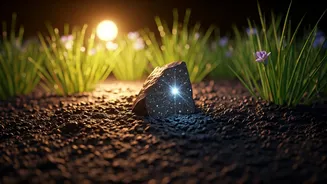
How do you tell a space rock from a garden rock? Meteorite hunters look for specific clues. Many meteorites contain a high concentration of iron and nickel, making them unusually dense and magnetic. A magnet on a string is a classic hunter's tool. The most telling feature is often the 'fusion crust'—a thin, dark, glassy coating formed when the meteorite's outer surface melted during its atmospheric entry. It can look like a charcoal briquette or have distinctive 'thumbprints' called regmaglypts, created by the airflow during its descent. While thousands of meteorites fall to Earth each year, most land in oceans or remote areas, so finding one is still an exceptionally rare and exciting event.
A Message in a Stone Bottle
Finding an ancient meteorite is more than just a curiosity; it's a scientific treasure hunt. Each one is a pristine sample of the early solar system, a 'message in a bottle' that has travelled billions of kilometres and billions of years to reach us. Scientists can analyse their composition to understand how planets formed. Some rare meteorites, originating from Mars or the Moon, give us direct samples of other worlds without the need for a multi-billion-dollar mission. They contain exotic minerals not found on Earth and, in some cases, complex organic molecules—the building blocks of life. They are time capsules that help us piece together the grand story of our cosmic origins.