




A Visitor From Another Star
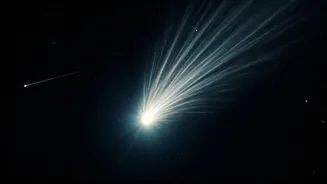
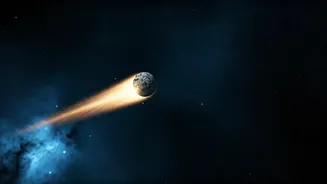
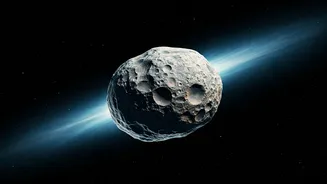
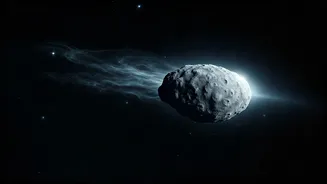
On July 1, 2025, astronomers using the Asteroid Terrestrial-impact Last Alert System (ATLAS) in Chile spotted a faint object moving across the sky. Its path was unusual. Instead of following a predictable, elliptical orbit around the Sun like our planets
and local comets, this object was on a hyperbolic trajectory. This meant it was moving too fast to be captured by the Sun's gravity, a clear sign that it came from interstellar space—the vast expanse between stars. Designated 3I/ATLAS, it became only the third such interstellar object ever confirmed, after the mysterious 'Oumuamua in 2017 and 2I/Borisov in 2019. While it posed no threat, passing millions of kilometres from Earth, it offered an unprecedented chance to study a piece of another, unknown star system up close.
Reading the Chemical Clues
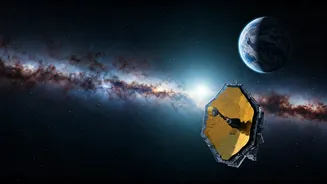
Comets are often called 'dirty snowballs'—amalgamations of ice, dust, and frozen gases left over from the formation of a star system. They are pristine relics, preserving the chemical makeup of their birth environment. To understand 3I/ATLAS's origins, scientists pointed the world's most powerful telescopes, including the James Webb Space Telescope (JWST), at the visitor as it was warmed by the Sun. The heat caused its ices to sublimate into gas, creating a surrounding cloud, or coma, that could be chemically analyzed. The results were stunning. The comet's water contained an exceptionally high concentration of deuterium, a heavy form of hydrogen. In fact, the deuterium-to-hydrogen ratio was about 30 times higher than what is seen in comets from our own solar system.
A Fingerprint of Ancient Times
This high deuterium level suggests the comet formed in an extremely cold environment, far colder than the nursery where our own solar system’s comets were born. Such conditions would have existed much earlier in the galaxy's history. Further analysis of its carbon isotopes provided another crucial clue. The comet had a low ratio of a heavier carbon variety (carbon-13) to the more common carbon-12. Over cosmic time, galaxies become progressively enriched with heavier elements, including carbon-13, as generations of stars live and die. The comet's particular chemical signature points to it having formed from material that was not heavily processed by many stellar cycles. Based on these isotopic fingerprints, scientists have estimated that 3I/ATLAS could be between 10 and 12 billion years old.
Older Than the Sun Itself
To put that age in perspective, our Sun and the entire solar system are about 4.6 billion years old. If the estimates are correct, 3I/ATLAS formed more than twice as long ago, during a period astronomers call the 'cosmic noon,' when star formation across the universe was at its peak. This makes it potentially the oldest object ever directly observed in our solar system. It likely originated in the Milky Way's 'thick disk,' a region populated by ancient stars. Billions of years ago, it was probably ejected from its original star system by gravitational forces and began its long, lonely journey through interstellar space, a journey that eventually brought it through our own cosmic neighbourhood.