


The Old Story: A Chaotic Beginning
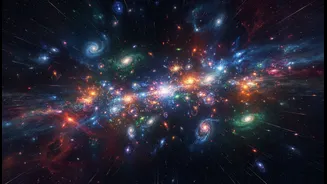
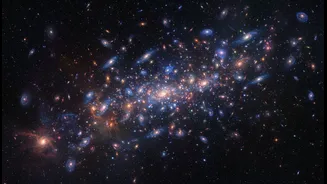
The long-accepted story of how galaxies came to be is known as the hierarchical model of formation. It paints a picture of a messy, violent early cosmos. In this view, the universe began with small, irregular clumps of matter and dark matter. Over billions
of years, these small proto-galaxies crashed into each other, merging and growing larger through countless chaotic collisions. According to this theory, the grand, well-structured spiral and disk galaxies we see today, like our own Milky Way, are the end product of this long, disorderly process. Scientists believed these elegant, rotating disks couldn't have existed in the early universe because the constant mergers would have torn them apart. It was thought that stable disk galaxies only appeared much later, once the universe had settled down, perhaps around 6 billion years after the Big Bang.
A Surprise from the Cosmic Dawn
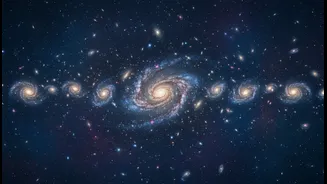
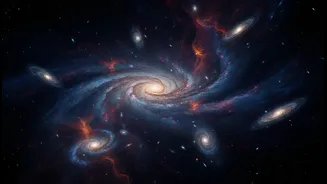
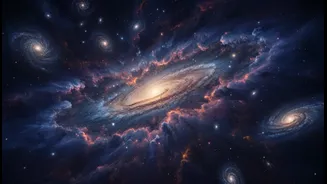
Recent discoveries, primarily from the James Webb Space Telescope (JWST), are turning this old story on its head. Astronomers are now seeing things they didn't think were possible. Looking back to within the first few billion years of the universe's existence, they are finding galaxies that are far from chaotic. Instead of small, messy blobs, the JWST has revealed surprisingly mature and well-structured galaxies. A recent study highlighted that galaxies with orderly, rotating disks—similar in structure to our Milky Way—are ten times more common in the early universe than previously believed based on older observations. Some of these well-formed galaxies have been found dating back to when the universe was just a few billion years old, far earlier than the hierarchical model would predict.
What Makes a Galaxy 'Orderly'?
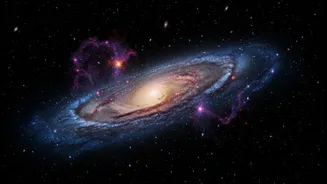
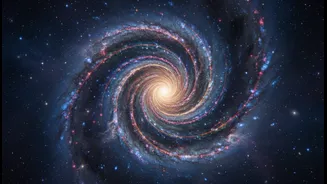
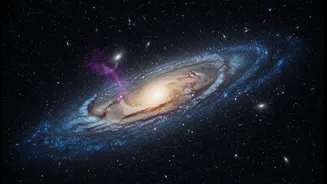
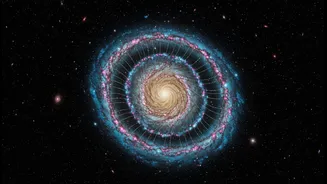
When astronomers talk about 'order' in a galaxy, they are often referring to its shape and motion. A messy, chaotic galaxy is typically an irregular clump of stars and gas with no defined pattern. An 'orderly' galaxy, on the other hand, often has a distinct, flattened disk shape where stars and gas rotate in a coherent, stable fashion, much like a spinning record. The discovery of these rotating disk galaxies, some with complex internal features like stellar bars and nuclear disks, suggests a much faster and more efficient formation process. For example, astronomers from Durham University recently identified a nuclear disk—a dense, star-forming structure at a galaxy's core—in a galaxy seen more than nine billion years ago, a feature previously only seen in modern, mature galaxies. These are not the 'train wrecks' astronomers expected to see.
The Tool That Changed the Game
This radical rethinking is largely thanks to the James Webb Space Telescope. Launched in 2021, its powerful infrared instruments allow it to peer deeper into space—and therefore further back in time—than any observatory before it. Because light from distant objects takes billions of years to reach us, seeing these ancient galaxies is like looking through a time machine to the universe's infancy. Where previous telescopes like Hubble saw faint, fuzzy smudges, the JWST’s incredible sensitivity and resolution reveal sharp details, uncovering the true shapes and structures of these first cosmic cities. It is this unprecedented clarity that has allowed scientists to identify these unexpectedly advanced galaxies and challenge the established timeline of cosmic evolution.
What Does This Mean for Science?
These findings don't necessarily mean the old model of galaxy formation is completely wrong, but they prove it's incomplete. Science is a process of refinement, and this new evidence forces a major update. The existence of massive, orderly galaxies so early on suggests that they must have grown up much faster and more efficiently than thought. Some may have formed not through a long series of messy mergers, but perhaps through a smoother, more rapid accretion of cold gas from the cosmic web. These discoveries are opening up new questions and even prompting some scientists to reconsider fundamental aspects of cosmology, including the nature of dark matter and gravity itself. The universe, it seems, was capable of building organised structures far earlier and faster than we ever imagined.