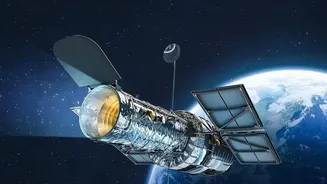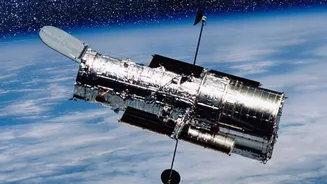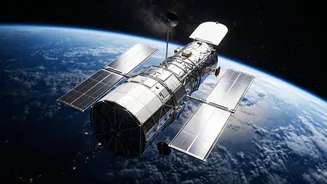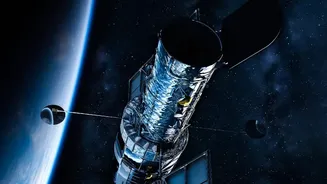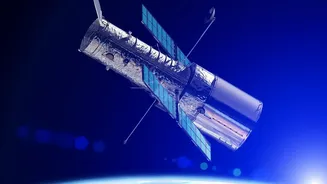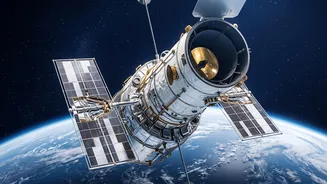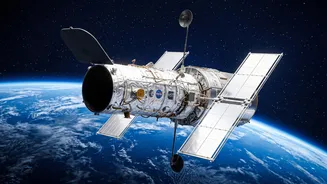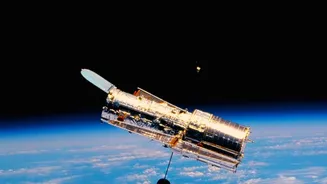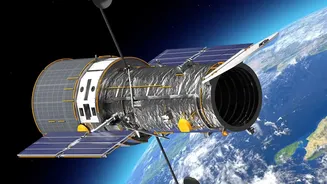



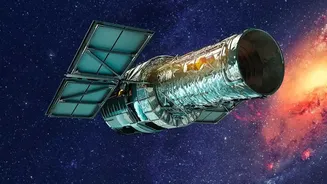
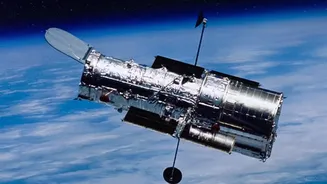
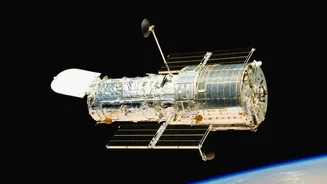
For over three decades, the Hubble Space Telescope has been humanity's eye on the cosmos. Now, its legendary mission is at risk as its orbit slowly decays, prompting NASA to look to the commercial space industry for a potential rescue.
An Icon's Slow Descent
Since its launch
in 1990, the Hubble Space Telescope has fundamentally reshaped our understanding of the universe, contributing to over 19,000 scientific papers. But after more than 36 years and billions of kilometres travelled, the legendary observatory is facing a slow, inevitable pull back to Earth. With no onboard propulsion system, Hubble relies entirely on its altitude to stay in orbit. Atmospheric drag, the constant friction from the tenuous outer layers of Earth's atmosphere, is causing its orbit to gradually shrink. The last time astronauts boosted its altitude was during a Space Shuttle mission in 2009. Since then, its orbit has been in a steady, uncorrected decline.
The Numbers Behind the Fall
Hubble's altitude has dropped from about 583 kilometres after its last servicing mission to around 470-480 kilometres today. This gradual descent means that without intervention, NASA projects the telescope will make an uncontrolled re-entry into Earth's atmosphere sometime between 2033 and 2038. The exact timing depends heavily on solar activity, which can cause the atmosphere to expand and increase drag. To prevent a fiery, uncontrolled end for the 11,000-kilogram observatory, any potential rescue mission would need to happen by 2032.
A Call for Commercial Heroes
Recognizing the urgency, NASA issued a formal Request for Information (RFI) on October 29, 2026, inviting the commercial space industry to propose solutions. The agency has laid out three main options: boost Hubble to a higher orbit, service it with new technology, or perform a controlled de-orbit to ensure it comes down safely. This isn't a formal contract but rather a market survey to see what's possible. Companies have until November 30, 2026, to submit their ideas, outlining their technical concepts, launch plans, and estimated costs for saving the national icon. NASA has clarified that it has not allocated any funding for a mission at this stage.
The Race to Devise a Rescue
This call to action opens a new chapter in the relationship between NASA and the private space sector. A commercial provider would be responsible for the entire mission, from the launch vehicle and spacecraft to operations. Previous studies have already explored the feasibility of such a mission. In 2022, NASA and SpaceX conducted a study on using a Dragon spacecraft to rendezvous with and reboost the telescope. While that specific plan was not pursued, it demonstrated that the concept was technically possible. Other players, like Astroscale and Momentus, have also previously proposed a joint robotic mission to raise Hubble's orbit and clear nearby debris.
More Than Just a Boost
The proposals could go beyond a simple push to a higher orbit. The RFI also opens the door for a full servicing mission, potentially upgrading Hubble's 36 year old systems and extending its scientific productivity for many more years. Boosting the telescope to an altitude of 600 kilometres could add another 15 to 25 years to its operational life. A successful commercial mission would set a powerful precedent, proving that private companies can help maintain and extend the life of critical and expensive government assets in space. It would represent a shift from building and launching new infrastructure to servicing what is already there, a key step toward a more sustainable and dynamic space economy. The outcome of this call could determine not only the future of Hubble but also the future of public–private partnerships beyond our world.