

A Prophecy of Fire and Ice
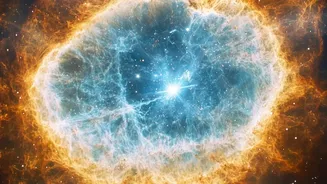
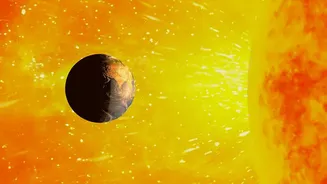
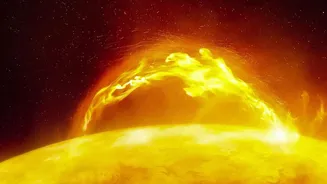
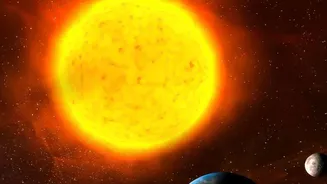
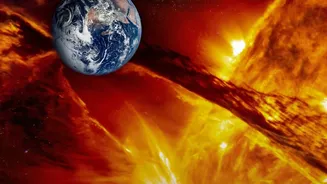
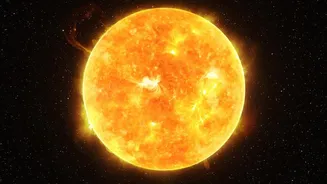
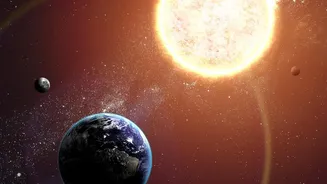
In about five billion years, our Sun will exhaust the hydrogen fuel in its core. It will then swell into a red giant, expanding to more than 100 times its current size and engulfing the inner planets—Mercury, Venus, and possibly Earth. After this cataclysmic
phase, it will shed its outer layers and shrink into a white dwarf, a dense, Earth-sized stellar remnant that will slowly cool over eternity. For decades, scientists believed the surviving outer planets, from Jupiter outward, would simply drift into wider, stable orbits and continue their silent dance for trillions of years. However, new, more sophisticated models suggest a far more chaotic and dramatic future, one where the final act is not a gentle fade to black, but a period of violent instability.
The Gravitational Architects
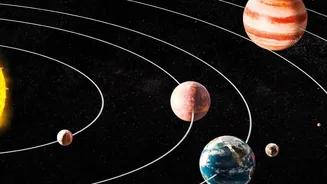
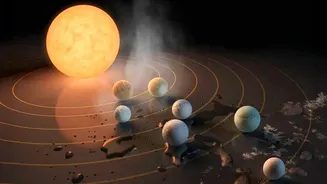
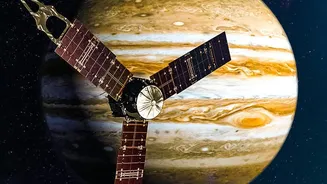
Jupiter and Saturn are not just the two largest planets in our solar system; they are its gravitational architects. Their immense mass and orbital relationship have shaped the system we see today. Early in the solar system's formation, their gravitational interplay is thought to have prevented Jupiter from migrating too close to the Sun, a fate that befalls many 'Hot Jupiters' in other star systems. This 'Grand Tack' migration, where Jupiter moved inward before being pulled back out by Saturn, likely sculpted the asteroid belt and limited the material available to form Mars. Their current stable resonance, where Jupiter orbits the Sun roughly five times for every two orbits of Saturn, acts as a gravitational backbone, keeping the other planets in check. This delicate balance, however, may not survive the Sun’s death.
Rethinking the Final Act
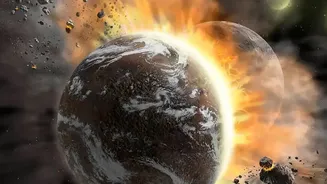
The latest research, led by astrophysicists at the California Institute of Technology, paints a different picture of the Sun's demise. Previous models assumed the Sun would lose mass smoothly and gradually. The new simulations incorporate a more realistic scenario: the Sun will shed its mass in violent, asymmetric bursts. These bursts will act like 'stochastic kicks', delivering small but significant gravitational nudges to the remaining planets. Over thousands or millions of years, these repeated kicks will disrupt the fragile orbital harmony that keeps the giant planets in their lanes. The once-stable system will descend into chaos, leading to a cosmic demolition derby.
A Future of Cosmic Chaos
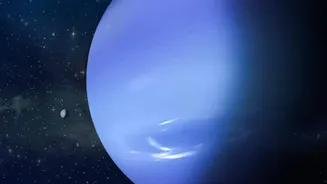
The results of hundreds of simulations are startling. Instead of surviving for a quintillion years, the new study predicts the outer solar system could destabilize within just a few billion years after the Sun becomes a white dwarf—a timeline 100 times faster than previously thought. In about 90% of the simulations, at least one giant planet gets ejected from the solar system entirely, destined to become a rogue planet wandering interstellar space. The simulations show scenarios where Uranus and Neptune swap orbits, or where Saturn is flung out into the cosmic darkness. In a significant number of cases, this instability begins even before the Sun has fully transformed into a white dwarf, as its mass loss starts to shake the foundations of the planetary architecture.
Why This Cosmic Forecast Matters
While this future is billions of years away, these findings have profound implications for our understanding of how planetary systems evolve and die across the galaxy. It suggests that the calm, orderly systems we see today might be the exception, not the rule, over cosmic timescales. Furthermore, it helps explain a growing astronomical mystery: the existence of so many free-floating planets detected by microlensing surveys. Dying suns ejecting their giant planets could be a major source of these cosmic wanderers. By studying the potential end of our own solar system, we gain a crucial window into the life cycles of countless other systems, helping us piece together the grand narrative of planetary formation, stability, and eventual dissolution.