



An Illusion of Solidity
When Galileo first observed Saturn in 1610, his telescope wasn't powerful enough to resolve the rings, making him think the planet had 'ears'. It wasn't until 1655 that Christiaan Huygens correctly proposed that Saturn was surrounded by a ring. For centuries,
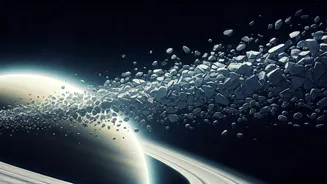
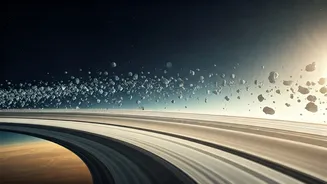
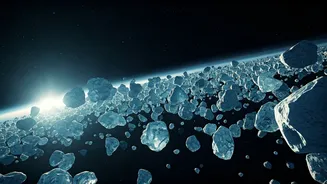
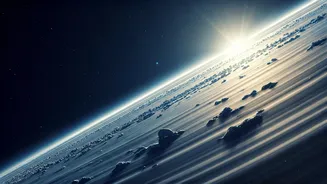
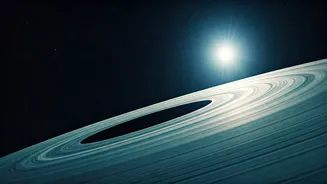
we’ve refined that understanding. What appears as a continuous, solid structure from millions of kilometres away is actually a vast, flat disc composed of billions, perhaps trillions, of separate particles, all orbiting the gas giant in a cosmic dance. The rings are incredibly wide, stretching up to 282,000 kilometres from the planet, but they are astonishingly thin—in most places, only about 10 metres thick. If you were to scale the system down, the rings would be proportionally thinner than a sheet of paper.
What Are the Chunks Made Of?
The overwhelming majority of the material in Saturn’s rings is water ice. We’re not talking about a little frost; these are chunks of nearly pure frozen water. Data from NASA’s Cassini spacecraft, which studied Saturn for 13 years, confirmed that the rings are about 99.9% water ice, with only a tiny fraction of rocky material and dust mixed in. This incredible purity is actually a major clue for scientists trying to understand the rings' origin and age. The pristine nature of the ice suggests they might be much younger than the planet itself. If they had been around for billions of years, they would have been 'polluted' by a great deal more dust and meteorite debris from the outer solar system, making them darker and less brilliant.
From Dust Grains to Mountain-Sized Boulders
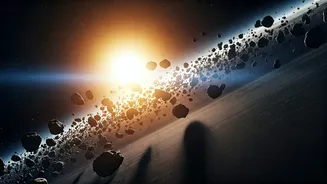
The 'chunks' that form the rings come in an enormous range of sizes. Most are tiny, like grains of sand or dust. A large portion are pebble-sized or the size of a hailstone. But scattered among these are much larger members: boulders the size of a car, chunks as big as a house, and even a few 'moonlets' that can be a kilometre or more across. Imagine a blizzard where the snowflakes range from microscopic specks to entire buildings, all swirling around a central point at breathtaking speeds—around 70,000 kilometres per hour. This constant, high-speed jostling prevents the particles from clumping together to form a proper moon, keeping them in their spectacular, dispersed state.
A Violent Origin Story
So where did all this ice come from? The leading theory points to a catastrophic event. Scientists believe that roughly 100 to 200 million years ago—relatively recently in cosmic terms, during the age of dinosaurs on Earth—one of Saturn's icy moons may have strayed too close to the planet. Saturn’s immense gravity would have exerted powerful tidal forces, a gravitational pull so strong it literally tore the moon apart. This unfortunate moon, or perhaps a pair of moons that collided, shattered into countless pieces. These fragments didn't fall into the planet or escape into space; instead, they settled into a flat, orbiting disc, which over millions of years spread out to form the intricate ring system we see today.
The Shepherds of the Rings
The rings are not a simple, uniform disc. They are a complex structure of thousands of individual ringlets and gaps. This intricate pattern is sculpted by the gravitational pull of Saturn’s many moons. Small moons that orbit near or within the rings, known as 'shepherd moons', act like cosmic sheepdogs. Their gravity nudges and corrals the ring particles, keeping the edges of the rings sharp and creating the famous gaps, like the Cassini Division, a 4,800-kilometre-wide gap visible from Earth. These gravitational interactions are responsible for the waves, braids, and other delicate structures that make the rings so dynamic and fascinating.