






A Lunar Layer Cake
The Moon’s surface may appear to be a uniform sea of dust, but new findings from ISRO scientists show that what lies just beneath is a surprisingly structured world. Analysis of data from the Chandra’s Surface Thermophysical Experiment (ChaSTE) on the Vikram
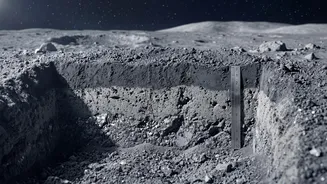
lander has identified three distinct layers of soil, or regolith, within the top 10 centimetres at the south polar landing site. This finding, published in the prestigious Nature Portfolio journal, challenges previous assumptions that the lunar topsoil was largely homogenous. A study led by K Durga Prasad of the Physical Research Laboratory (PRL), Ahmedabad, details this fascinating discovery, which provides the first-ever direct thermophysical profile of the Moon's southern high-latitude region.
Peeling Back the Layers
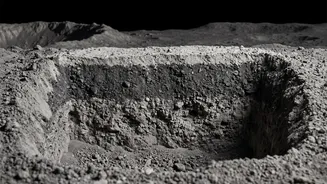
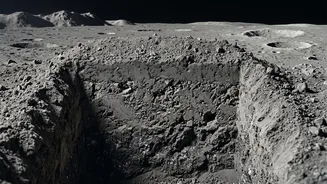
The ChaSTE instrument, a probe that penetrated the lunar surface, revealed the soil's hidden complexity. The topmost layer, extending down about 3 cm, is a highly porous, 'fluffy' material with a porosity of around 80% and a low density of about 600 kg per cubic metre. Below this lies a middle layer, from 3 to 6 cm deep, which has a higher thermal conductivity. The third and deepest layer measured, between 6 and 10 cm, is denser still, with its density reaching approximately 1,500 kg per cubic metre. This layered structure shows that the lunar regolith has diverse geotechnical and thermophysical properties at different depths, a fine-scale layering that was neither observed nor expected before.
How the 'Hop' Helped Science
This detailed three-layer model builds upon earlier findings. An initial analysis, published in April 2026, had identified a two-layer structure. That data came after the Vikram lander performed a historic 'hop' manoeuvre on September 3, 2023, firing its engines to lift off and land again a short distance away. The engine exhaust blew away the uppermost 2-3 cm of fluffy soil at the new location, allowing ChaSTE to analyse the underlying, more compacted layers. By combining data from both the original, undisturbed landing site and the post-hop site, scientists were able to construct the complete three-layer profile, confirming the existence of the incredibly porous top layer.
A Tale of Two Temperatures
The layered structure has a dramatic effect on how the Moon handles heat. One of the most striking observations from ChaSTE was a massive temperature difference of about 73 Kelvin (a drop of 73 degrees Celsius) across the top 10 cm of soil at local noon. The highly porous top layer acts as an incredibly effective thermal insulator, preventing the Sun's heat from penetrating deeper into the surface. This finding is crucial, as it confirms that while the lunar surface can get very hot, the subsurface remains extremely cold, a condition necessary for preserving resources like water ice in permanently shadowed regions.
Why This Finding Matters for India and the World
Understanding the physical properties of the lunar regolith is vital for the future of space exploration. For any mission planning to build habitats, excavate resources, or even just drive rovers, knowing how the ground behaves is critical. This detailed soil analysis from Chandrayaan-3 provides invaluable ground-truth data for designing future lunar infrastructure that can withstand the Moon's extreme environment. The discovery not only enhances our scientific knowledge of the Moon's geology and history but also solidifies India's role as a key player in lunar science. It is a testament to the sophisticated instrumentation of the Chandrayaan-3 mission and the ingenuity of ISRO's scientific teams.