


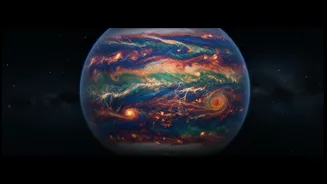



A New Cosmic Weather Report
For centuries, astronomers were limited to studying the few planets within our own cosmic neighbourhood. Now, thanks to the unprecedented power of new observatories like the James Webb Space Telescope (JWST), we are getting our first detailed look at the weather
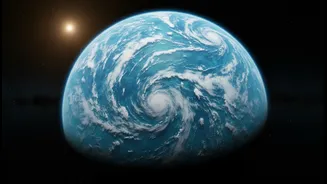
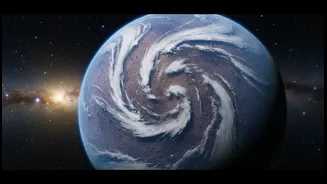
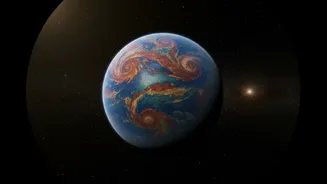
on worlds light-years away. Recent findings have confirmed the presence of water vapour, a crucial ingredient for life as we know it, across a range of these exoplanets. These aren't just one-off detections; scientists are beginning to build a catalogue of worlds with water in their skies, moving us from speculation to observation. This marks a profound shift in our ability to assess which of the thousands of known exoplanets might have the right conditions for life.
Reading Light From Trillions of Kilometres Away
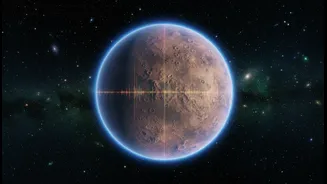
So how do you study the atmosphere of a planet you can't even see directly? The primary method is called transit spectroscopy. When an exoplanet passes in front of its host star from our point of view, a tiny fraction of the starlight filters through the planet's atmosphere. Different molecules in that atmosphere absorb specific colours, or wavelengths, of light. Think of it like a barcode; water vapour has a unique pattern of absorption lines. By capturing the starlight before, during, and after the planet's transit, astronomers can subtract the difference and reveal the chemical 'barcode' of the atmosphere itself. What was once a theoretical technique is now a proven, powerful tool, allowing scientists to identify molecules like water, methane, and carbon dioxide from incredible distances.
The Habitable Zone Gets an Update
For years, the search for life has focused on the 'habitable zone'—often called the 'Goldilocks zone'—the region around a star where temperatures are just right for liquid water to exist on a planet's surface. However, this new ability to detect atmospheric water vapour adds a critical layer of evidence. A planet can be in the right zone, but if it has no water or a toxic atmosphere, it's not a great candidate for life. Conversely, some planets outside the traditional zone might have thick atmospheres that create habitable conditions. The latest research is helping scientists refine their targets, focusing on rocky worlds like LHS 1140 b, a planet in its star's habitable zone that has shown strong evidence of a substantial atmosphere. These atmospheric clues are essential for distinguishing truly promising worlds from those that are merely in a good location.
Not A Guarantee, But A Guide
It is crucial to understand that finding water vapour is not the same as finding life, or even liquid oceans. Planets like GJ 9827d, which is only about twice the diameter of Earth, may have a water-rich atmosphere but be far too hot for that water to be liquid on the surface. In some cases, as seen on 'sub-Neptune' type planets, the world might be a hot, steamy place with clouds of vaporised rock and no solid surface to speak of. But each detection provides a vital data point. Scientists can now compare the atmospheres of different planets in the same system, looking for anomalies that might hint at geological or even biological processes. These water signatures are not an answer, but a guidepost, pointing astronomers toward the most interesting planets deserving of further, more intense study.