





The Dark Matter Problem
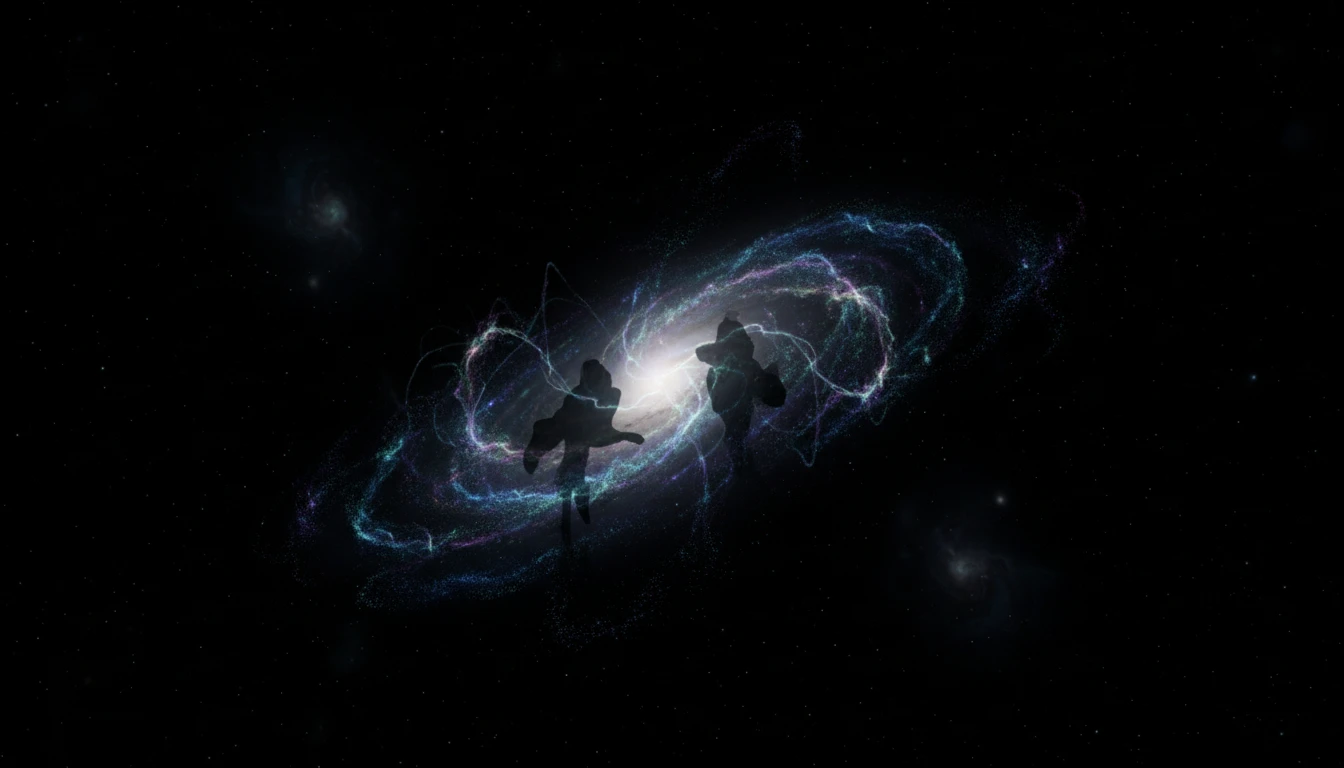
First, let's appreciate the scale of the problem. For decades, astronomers have observed that galaxies spin so fast they should fly apart. Stars, gas, and dust just don't have enough gravity to hold everything together. The only way the math works is
if there's an enormous amount of invisible matter providing the extra gravitational glue. This isn't a minor error; scientists believe dark matter makes up about 85% of all matter in the universe. We are certain it exists because we see its gravitational effects everywhere, but we have never directly detected it. It doesn’t interact with light or any other form of radiation, making it completely invisible and one of the biggest unsolved mysteries in all of physics.
Enter the Fifth Dimension
This is where things get truly mind-bending. The idea of extra dimensions isn't new; it has been a feature of theoretical physics for about a century, primarily in string theory. These aren't dimensions you can travel to, but rather tiny, curled-up spaces that exist at every point in our reality. A recent theory from physicists at the University of Sheffield proposes that dark matter might exist within one such hidden dimension. This concept, often called a "braneworld" theory, imagines our familiar three-dimensional universe as a 'brane' floating in a higher-dimensional space, or 'bulk'. While our standard model particles and forces are stuck on this brane, gravity might be able to leak across these dimensions.
A Resonance in the Dark
The latest spin on this idea is particularly elegant. The Sheffield theory suggests that dark matter particles and a hypothetical 'dark photon' both live in this fifth dimension. The specific geometry of that dimension would cause the particles’ masses to resonate, much like a guitar string vibrates at a specific frequency to produce a clear note. This 'resonant dark matter' model is appealing because it solves a nagging problem. It could explain why dark matter seems to have interacted strongly in the early, dense universe but is almost inert and undetectable today. Critically, this resonance would arise naturally from the dimension's geometry, rather than requiring physicists to artificially fine-tune their models—a practice many find unsatisfactory.
The Search for Proof
An elegant theory is one thing, but science demands proof. A scientific theory is only useful if it makes predictions that can be tested. A hypothesis that cannot, in principle, be proven false is not considered scientific. So, how could we ever prove something as outlandish as a hidden dimension? The answer lies in looking for its subtle effects on our world. Some theories predict that interactions in a fifth dimension could produce specific types of gravitational waves—ripples in spacetime—that our next generation of detectors might be able to sense. Others suggest that high-energy particle collisions at facilities like the Large Hadron Collider could create particles that vanish into the extra dimension, leaving behind a tell-tale signature of missing energy and momentum.
Why You Should Be a Skeptic (A Healthy One)
This is the most important part for any physics enthusiast or student. The process of science is not about blindly accepting exciting ideas. It's an ongoing, interactive process of proposing hypotheses, testing predictions, and failing to falsify them. A theory is validated not by a single 'eureka' moment, but by surviving relentless scrutiny from countless experiments and observations. Theories of extra dimensions and dark matter are at the absolute frontier of our knowledge. They represent our most creative attempts to explain the universe's deepest puzzles. While the idea of a fifth dimension is captivating, its true value lies in whether it can guide us to new, verifiable discoveries. Until then, it remains a fascinating, but unproven, possibility.