
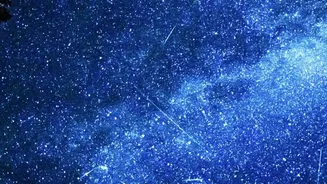
Start with Just Your Eyes
The most essential tool for stargazing is one you already have. Before you think about telescopes, start by simply looking up. Find the darkest spot you can, whether it’s a balcony, a backyard, or a nearby park with minimal streetlights. Turn off all
the lights in and around your home and give your eyes at least 20 minutes to fully adapt to the darkness. During this time, avoid looking at your bright phone screen. If you need a light, use a red flashlight, as red light is less disruptive to your night vision. To help you identify what you’re seeing, you can use a stargazing app on your phone, but be sure to switch it to its red-light mode to preserve your adjusted vision.
A Little Gear Goes a Long Way
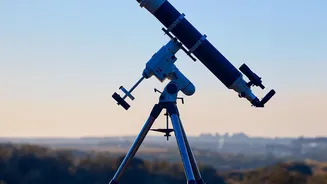
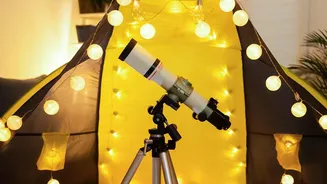
While not essential, a few simple items can significantly enhance your experience. A good pair of binoculars is perhaps the best first investment for a budding astronomer. They are more intuitive to use than a telescope and are perfect for getting a closer look at the Moon’s craters, star clusters, and even the brighter planets. Another helpful tool is a planisphere, or star wheel, which can help you identify constellations visible on any given night. Finally, bring a comfortable chair or blanket. Stargazing involves a lot of patience and looking up, so being comfortable will allow you to enjoy the celestial show for longer.
Planets on Parade This October
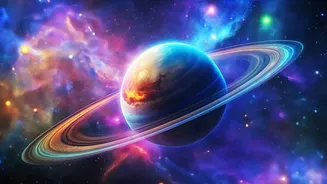
October 2026 is an excellent month for planet-watching. Saturn is the star of the show, reaching opposition on October 4. This means Earth is passing directly between Saturn and the Sun, making the ringed planet appear at its biggest and brightest for the year, visible all night long. Jupiter rises in the early morning hours, shining brightly in the eastern sky before dawn. Mars also makes an appearance in the pre-dawn sky, identifiable by its reddish hue. Early in the month, you might also catch a glimpse of Venus and Mercury low on the western horizon just after sunset, though they can be tricky to spot.
Catch a Falling Star (or Two)
October hosts two notable meteor showers. First up are the Draconids, peaking on the evening of October 8-9. This is an unusual shower because it's best viewed in the evening, just after nightfall, rather than in the early morning hours. This year's Draconids are expected to have excellent viewing conditions with an almost moonless sky. Later in the month, the Orionid meteor shower, which is debris from the famous Halley's Comet, peaks on the night of October 21-22. These meteors are known for being fast and bright. A bright moon will interfere in the evening, but it sets a few hours before dawn, opening a dark window for prime viewing in the early morning hours.
Find Your Way with Autumn Constellations
Learning constellations is like creating a map of the night sky. Start with something easy to find in the Northern Hemisphere, like Cassiopeia, which forms a distinctive 'W' or 'M' shape. From there, you can try to locate the Great Square of Pegasus, a large square of stars that is a prominent feature of the autumn sky. For a real challenge, use Cassiopeia as a guide to find the Andromeda Galaxy (M31). In a dark sky, it appears as a faint, fuzzy smudge of light to the naked eye, but through binoculars, it becomes more distinct. Seeing the light from another galaxy over 2.5 million light-years away is a truly awe-inspiring experience.